
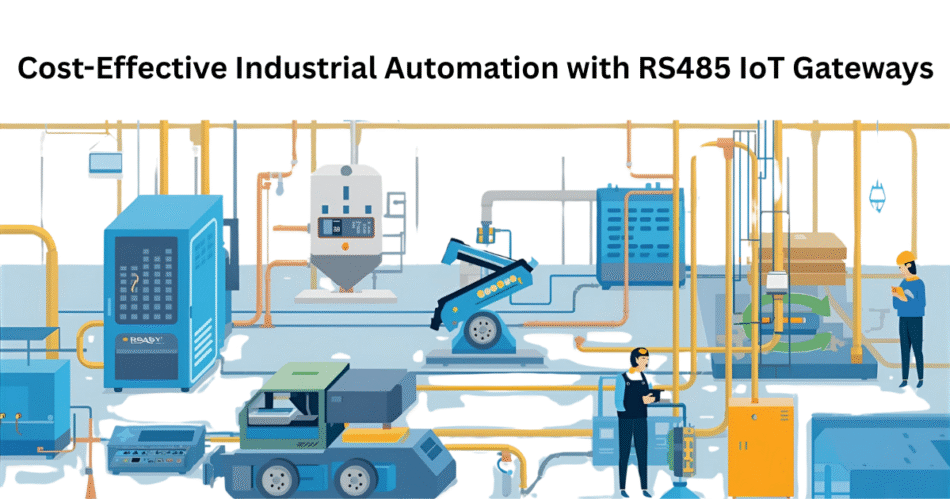
Industrial automation is undergoing a rapid shift as organizations strive to modernize operations, reduce costs, and adopt data-driven approaches. However, a large portion of industrial equipment—especially motors, PLCs, drives, meters, and sensors—still relies on RS485 serial communication. These legacy systems are reliable and long-lasting but lack modern networking and cloud connectivity.
Instead of replacing entire systems or upgrading expensive machinery, industries are increasingly using RS485 IoT Gateways as a cost-effective, scalable, and non-disruptive solution. These gateways act as a bridge between traditional RS485-based devices and modern digital platforms, allowing industries to adopt IIoT (Industrial Internet of Things) without heavy investment.
This detailed blog explores how RS485 IoT Gateways reduce automation costs, improve operational visibility, and unlock Industry 4.0 features with minimal infrastructure changes.
1. Understanding RS485 IoT Gateways in Industrial Automation
1.1 What Is RS485?
RS485 is a robust and widely used standard for serial communication in industries. It’s known for:
- Long-distance communication (up to 1200 meters)
- Noise immunity in industrial environments
- Multi-drop capability (up to 32 devices on a line)
- Low-cost cabling and hardware
Equipment using RS485 includes:
- PLCs
- Energy meters
- Solar inverters
- VFDs (Variable Frequency Drives)
- HVAC controllers
- Sensors and actuators
Many of these devices support Modbus RTU, a common serial communication protocol.
1.2 What Does an RS485 IoT Gateway Do?
An RS485 IoT Gateway connects RS485 devices to cloud platforms, SCADA systems, and enterprise networks. It typically supports:
- RS485/RS232 serial port
- Ethernet / Wi-Fi / 4G LTE connectivity
- Modbus RTU to Modbus TCP conversion
- MQTT, HTTP, HTTPS, CoAP, WebSocket protocols
- Edge processing and real-time alerts
By converting serial data into IP-based data, it makes legacy equipment “smart” and accessible from anywhere.
2. Why RS485 IoT Gateways Are a Cost-Effective Solution
2.1 Elimination of Equipment Replacement Costs
Replacing legacy equipment with modern IoT-enabled machines is extremely expensive. Industrial-grade hardware is known for long life cycles—many devices operate for 15–25 years.
Instead of spending thousands of dollars per machine, an RS485 gateway integrates with existing assets and enables modern functionality:
- Remote monitoring
- Data visualization
- Cloud storage
- Predictive maintenance
The result? 70–90% savings compared to a full equipment upgrade.
2.2 Minimal Infrastructure Changes Required
A major benefit of RS485 IoT Gateways is that they work with existing wiring, panels, and systems. No need to:
- Change cables
- Install new network switches
- Redesign control panels
- Modify PLC programming
The gateway integrates into the existing communication line. This reduces engineering costs, installation time, and downtime during deployment.
2.3 Reduced Operational Expenses Through Remote Monitoring
Industrial organizations spend heavily on:
- Physical inspections
- Field technician visits
- Manual data collection
- Troubleshooting and diagnostics
RS485 IoT Gateways enable real-time data transfer to:
- SCADA dashboards
- Cloud platforms like AWS, Azure, Google Cloud
- Custom mobile apps
- Local HMIs
This minimizes travel to remote sites and accelerates issue resolution, which cuts operational costs significantly.
2.4 Predictive Maintenance Reduces Breakdown Costs
Using real-time data from RS485 devices, the gateway enables predictive maintenance strategies such as:
- Early fault detection
- Alert on performance deviations
- Trend analysis
- Condition-based maintenance
This leads to:
- Lower repair costs
- Reduced downtime
- Extended machine lifespan
- Improved safety
Industries globally report a 30–40% reduction in maintenance expenses using IoT-based monitoring.
2.5 Avoiding Vendor Lock-In
Modern industrial communication tools often require expensive licenses and proprietary systems.
RS485 IoT Gateways support open standards like:
- MQTT
- Modbus
- REST APIs
- JSON data formats
This ensures organizations can integrate systems freely without recurring license charges.
3. Technical Features That Enhance Cost Efficiency
3.1 Multi-Protocol Conversion
Gateways can convert Modbus RTU to:
- Modbus TCP
- MQTT
- HTTP(S)
- WebSocket
This eliminates the need for expensive protocol converters or intermediary controllers.
3.2 Edge Computing and Local Automation
Advanced RS485 gateways offer:
- Local rule engine
- Threshold-based alerts
- Data filtering
- Local data storage
This reduces cloud dependency and ensures data continuity even during network failures.
3.3 Low Power Consumption
Gateways typically consume very little power (often <3W), making them ideal for:
- Battery-powered sites
- Remote locations
- Energy-sensitive applications
Low operational cost increases long-term affordability.
3.4 Flexible Connectivity Options
Gateways support multiple networking modes:
- Ethernet for stable industrial connectivity
- Wi-Fi for existing wireless networks
- 4G LTE for remote and unmanned sites
This flexibility eliminates the need for expensive wired infrastructure.
4. Real-World Industrial Applications of RS485 IoT Gateways
4.1 Manufacturing Plants
Use-cases include:
- Connecting PLCs and VFDs
- Monitoring motor health
- Gathering production data
- Energy monitoring of machines
This enables centralized dashboards and reduces manual logging.
4.2 Smart Energy & Utilities
Applications include:
- Solar inverter monitoring
- Electric meter data acquisition
- Water pump automation
- Diesel generator monitoring
Utility companies save money by eliminating physical meter reading and reducing outages.
4.3 Building Automation
RS485 is common in building systems like:
- HVAC chillers
- Fire alarm systems
- Access control systems
- Elevator controllers
- Lighting panels
Gateways modernize these legacy systems and bring monitoring to BMS dashboards or cloud apps.
4.4 Oil & Gas, Mining, and Heavy Industries
Industries operating in challenging terrains use gateways to monitor:
- Pipelines
- Pumps
- Compressors
- Remote sensors
LTE-enabled gateways reduce expensive field visits and enable real-time safety insights.
4.5 Agriculture and Smart Irrigation
RS485-driven irrigation controllers become fully automated through gateways. Benefits include:
- Soil moisture data collection
- Automated pump control
- Water usage optimization
- Reduced manual labor
This significantly lowers operational costs for large farms.
5. Long-Term Economic Advantages for Industries
5.1 Extended Equipment Lifecycle
By adding IoT capabilities, industries can continue to use reliable RS485 equipment while gaining modern functionalities—delaying large capital investments.
5.2 Reduction in Energy Consumption
IoT-based monitoring helps identify inefficient equipment, optimize load distribution, and reduce energy wastage.
5.3 Better Decision-Making Through Analytics
Data from RS485 devices can be transformed into smart insights through:
- Dashboards
- Reports
- Trend analysis
- AI-based recommendations
This enhances productivity and stabilizes operational costs.
5.4 Scalable and Future-Proof Architecture
The modular nature of RS485 gateways allows industries to expand their automation system without replacing existing components.
6. Case for RS485 IoT Gateways in Cost-Effective Automation
6.1 Faster Deployment and Reduced Downtime
Traditional industrial upgrades often require multiple stages:
- System shutdown
- Panel redesign
- Re-cabling
- Device reconfiguration
- On-site testing
This can result in hours—or even days—of production downtime, costing companies significant revenue, especially in process-critical industries like manufacturing, textiles, pharmaceuticals, or food processing.
RS485 IoT Gateways minimize this downtime, as they are:
- Plug-and-play
- Non-intrusive
- Compatible with existing communication lines
- Quick to configure (often through web UI or mobile apps)
Most installations complete within 15–45 minutes, ensuring operations continue uninterrupted.
6.2 Improved Data Accuracy and Elimination of Human Errors
Manual data collection in industrial systems is prone to:
- Typing mistakes
- Wrong meter readings
- Lost logs or data gaps
- Inconsistent reporting
- Inaccurate production analyses
With RS485 IoT Gateways:
- Entire data acquisition becomes digital
- Meter readings sync automatically
- Data logs are accurate, time-stamped, and consistent
- Performance reports are generated without human input
This eliminates human error and enhances the quality of analytics, enabling more accurate decision-making.
6.3 Enhanced Cybersecurity for Legacy Systems
Legacy RS485 devices often lack built-in security.
When connected directly to modern networks, they pose a risk.
RS485 IoT Gateways incorporate advanced security layers such as:
- Encrypted communication (TLS 1.2/1.3)
- Secure MQTT connections
- Device authentication
- Whitelisting and firewall rules
- VLAN and network segmentation
- Password-protected access
This protects legacy systems from cyber threats without upgrading the devices themselves—saving security infrastructure costs.
6.4 Ideal for Harsh Industrial Environments
Many modern IoT devices are designed for consumer use and cannot withstand:
- High temperatures
- Humidity
- Vibration
- Dusty environments
- Electrical noise
RS485 IoT Gateways are typically ruggedized and built for industrial conditions, offering:
- Wide operating temperature ranges
- Metal or reinforced enclosures
- ESD and surge protection
- EMI resistance
- Stable performance in noisy factory settings
This reduces device failure rates and replacement costs over time.
6.5 Support for Multi-Device Networking and Expansion
RS485 supports multi-drop networks where multiple devices share the same bus.
A single gateway can therefore:
- Read data from 8, 16, or even 32 devices on one line
- Handle multiple RS485 lines through multi-port versions
- Collect data from multiple Modbus slaves simultaneously
This multi-device support significantly reduces:
- Hardware cost per device
- Panel space
- Cabling costs
- Power consumption
It also enables scalable expansion—new devices can be added without major upgrades.
Conclusion
RS485 IoT Gateways offer one of the most cost-effective and practical pathways for industries to move toward digital transformation. By reducing infrastructure changes, improving data accuracy, strengthening cybersecurity, and enabling scalable connectivity, these gateways maximize the return on existing industrial investments. Their ability to deploy quickly, operate reliably in harsh conditions, and support multi-device networks further enhances affordability and long-term value.
For industries seeking modernization without a massive financial burden, RS485 IoT Gateways stand out as a smart and sustainable choice.


