
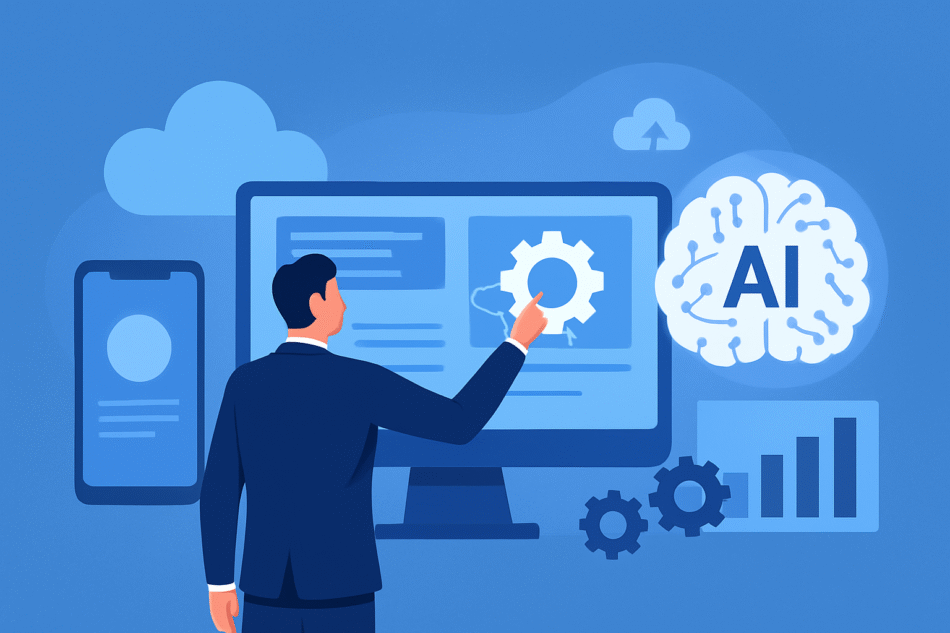
The rapid evolution of technology has fundamentally transformed how businesses operate, compete, and grow. Modern tools, especially advancements in AI and Machine Learning, are no longer optional luxuries but essential components for survival and success in today’s competitive landscape. These technologies are the new backbone of innovation, driving efficiency and creating unprecedented opportunities. Businesses that strategically embrace these advancements position themselves as industry leaders, while those that hesitate risk becoming obsolete.
This article will explore the profound impact of this technological revolution. We will delve into why AI and Machine Learning are critical for modern enterprises, examine the relationship between human expertise and artificial intelligence, and provide a clear roadmap for leveraging these tools to their full potential.
AI and Machine Learning: The Game Changers
At the forefront of this technological wave are AI and Machine Learning. These powerful tools empower businesses to analyze vast and complex datasets, automate repetitive and time-consuming processes, and make data-driven decisions with a speed and accuracy previously unattainable. From creating deeply personalized customer experiences to deploying predictive analytics for forecasting market trends, these technologies are actively reshaping industries across the globe.
For example, in the financial sector, machine learning algorithms are used to detect fraudulent transactions in real-time, saving institutions and customers billions of dollars annually. In healthcare, AI helps doctors diagnose diseases like cancer from medical images with greater precision. These applications are not futuristic concepts; they are practical solutions delivering tangible value today. Embracing AI and Machine Learning is no longer just about gaining a competitive edge; it’s about building a resilient and future-proof organization.
Human Expertise vs. AI: The Core Difference
A crucial distinction to understand is that AI and Machine Learning are powerful tools, but they do not replace the invaluable qualities of human expertise. While artificial intelligence brings computational power, human intelligence contributes creativity, contextual understanding, and emotional intelligence. The true power lies in the synergy between the two.
For instance, an AI can process millions of customer data points in seconds to identify purchasing patterns and predict future behavior. However, it lacks the nuanced ability to understand the cultural context behind those trends or make an empathetic decision during a sensitive customer interaction. This is where human expertise becomes irreplaceable, guiding the technology and interpreting its outputs to make well-rounded, strategic decisions.
As the saying goes:
“Technology is a useful servant but a dangerous master.”
This highlights the importance of maintaining human oversight and direction. When humans and AI work together, they can achieve results that neither could accomplish alone. The goal is augmentation, not replacement.
Efficiency and Scalability
One of the most significant benefits of integrating AI and Machine Learning is the dramatic improvement in operational efficiency and scalability. These systems excel at handling high-volume, repetitive tasks, such as data entry, invoice processing, or initial customer support inquiries. By automating these functions, businesses can free up their human employees to focus on more complex, strategic, and value-added initiatives.
Consider a retail company that implements AI-powered chatbots on its e-commerce site. These bots can provide 24/7 customer support, instantly answering common questions about order status, return policies, and product availability. During a major sales event, a human support team might be overwhelmed by the surge in queries, leading to long wait times and customer frustration. In contrast, an AI system can handle thousands of simultaneous conversations seamlessly, ensuring a consistently positive service experience and enhancing overall customer satisfaction. This allows the business to scale its support operations without a proportional increase in staffing costs.
AI and Machine Learning: The Silent Observers
Think of AI and Machine Learning systems as silent, tireless observers that are constantly monitoring and analyzing data streams. They provide the critical insights that fuel informed decision-making but do not, and should not, act with full autonomy. For example, a sophisticated machine learning algorithm in a manufacturing plant can predict that a piece of critical machinery is likely to fail within the next 48 hours based on sensor data. This alert is invaluable, but it requires human intervention to schedule maintenance, order parts, and adjust production schedules to prevent downtime.
Recognizing this limitation is key to successful implementation. Businesses must integrate AI and Machine Learning with clear workflows that involve human oversight. This ensures that the technology serves as an empowering tool for employees, providing them with the information they need to act decisively, rather than attempting to replace their judgment entirely. When technology alerts and human action work in harmony, organizations can proactively address problems before they escalate.
Personalization and Customer Experience
Modern consumers have come to expect highly personalized experiences. Generic, one-size-fits-all marketing and service no longer suffice. This is an area where AI and Machine Learning truly shine. By analyzing customer behavior, past purchases, browsing history, and demographic data, machine learning algorithms can deliver tailored recommendations and communications at scale.
Streaming platforms like Netflix and Spotify are prime examples. Their recommendation engines use AI to analyze viewing and listening habits to suggest new content that users are likely to enjoy. This keeps users engaged on the platform, increases satisfaction, and reduces churn. This same principle can be applied across industries. An e-commerce store can show a shopper products related to their recent searches, while a travel website can suggest vacation packages based on a user’s budget and past destinations. This level of personalization fosters a stronger customer connection, builds brand loyalty, and directly drives revenue.
Technology Can Fail, But Humans Adapt
While AI and Machine Learning are incredibly powerful, they are not infallible. Technical systems can experience outages, algorithms can contain hidden biases that lead to flawed outputs, and data sources can be compromised or become corrupted. In these moments of technological failure, human adaptability becomes the most critical asset for a business. Employees who are trained to work alongside technology can quickly step in to troubleshoot issues, manually override failed systems, and ensure business continuity.
Furthermore, humans possess a unique capacity for creativity and innovation in problem-solving. An AI can optimize a known process based on existing data, but it cannot invent a completely new solution or think outside the established parameters of its programming. When faced with an unprecedented market shift or a novel customer problem, it is human ingenuity that will devise a groundbreaking strategy. This is why the most successful businesses foster a culture that values both technological proficiency and human creativity, ensuring they have a balanced and resilient approach to navigating challenges.
Common Questions About AI and Machine Learning in Business
Q1: Will AI and Machine Learning replace human employees?
A: The primary goal is not replacement but augmentation. These technologies are best used to handle repetitive, data-intensive tasks, which frees up human employees to concentrate on roles requiring creativity, critical thinking, strategic planning, and emotional intelligence.
Q2: How can small businesses benefit from AI and Machine Learning?
A: Many AI solutions are now delivered via cloud-based platforms, making them more affordable and accessible than ever. Small businesses can use these tools for targeted marketing, customer service chatbots, inventory management, and sales forecasting to compete more effectively with larger enterprises.
Q3: Is it expensive to implement AI and Machine Learning?
A: While large-scale, custom implementations can require significant investment, many off-the-shelf and scalable solutions are available. The return on investment, realized through increased efficiency, lower operational costs, and higher revenue, often outweighs the initial expense.
Q4: What industries benefit the most from this technology?
A: Nearly every industry can leverage AI and Machine Learning for growth and innovation. This includes healthcare (diagnostics), finance (fraud detection), retail (personalization), manufacturing (predictive maintenance), and transportation (logistics optimization).
Q5: How can a business ensure the ethical use of AI?
A: Responsible AI implementation involves creating transparent governance policies, actively working to identify and mitigate biases in algorithms, protecting customer data privacy, and maintaining meaningful human oversight in all decision-making processes.
Conclusion
The technological revolution, spearheaded by AI and Machine Learning, is not a distant future trend it is the present reality of the business world. These transformative tools offer unparalleled opportunities to enhance efficiency, deliver superior customer experiences, and unlock new avenues for growth. However, their true power is only realized when they are integrated thoughtfully with the irreplaceable skills of human experts.
Businesses that embrace this powerful synergy combining the computational power of machines with the creative and strategic minds of their people will not only survive but thrive in the modern economy. They will lead their industries in innovation, build more resilient operations, and forge stronger connections with their customers. The time to act is now. Begin exploring how you can harness the power of AI and Machine Learning to secure your place in the future of business.


