
The Raspberry Pi5 has become a cornerstone for IoT prototyping and edge computing due to its powerful CPU, extensive GPIO pins, and affordability. However, many IoT applications—especially in remote or mobile environments—struggle to maintain consistent internet connectivity through Wi-Fi or Ethernet.
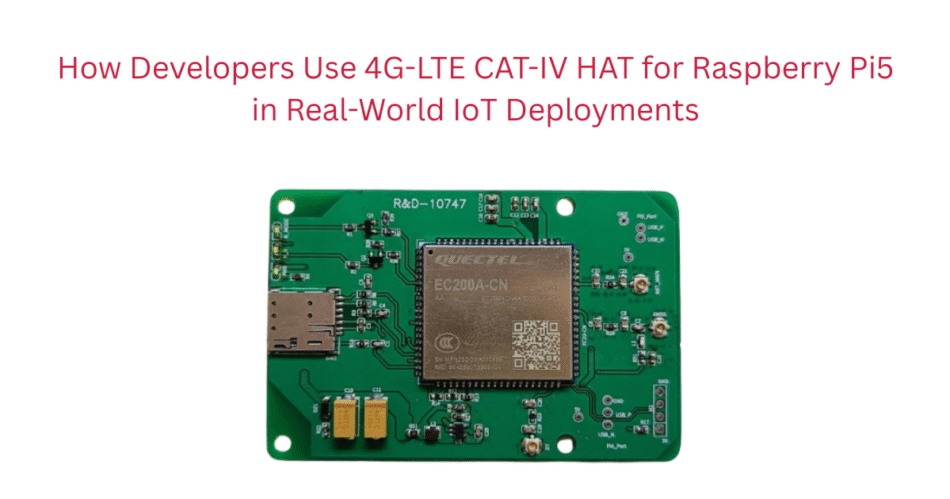
To bridge this gap, developers integrate the 4G-LTE CAT-IV HAT, a modular cellular communication board that adds high-speed LTE connectivity, GPS positioning, and remote data access to the Raspberry Pi. Together, this duo creates a flexible, mobile, and scalable IoT development platform ideal for field deployments.
Let’s dive deep into how developers are leveraging this setup for real-world IoT applications and the detailed technical reasoning behind each use case.
- 95% of the global population now has access to LTE networks (GSMA Report 2024).
- 75% of IoT deployments are expected to use cellular or LPWAN by 2030.
- IoT devices with LTE connectivity experience 40% fewer outages than Wi-Fi-based systems.
- LTE CAT-IV modules have an average latency of 50–70 ms, suitable for industrial control and telemetry.
1. What Is the 4G-LTE CAT-IV HAT for Raspberry Pi5?
A 4G-LTE CAT-IV HAT (Hardware Attached on Top) is an add-on board that provides cellular network connectivity to Raspberry Pi devices. It utilizes LTE CAT-IV technology, enabling download speeds up to 150 Mbps and upload speeds up to 50 Mbps.
The HAT attaches directly onto the Raspberry Pi5 via the GPIO header, and often connects through a USB interface for data communication with the onboard modem.
Technical Features:
- LTE CAT-IV Modem Module: Core component enabling 4G connectivity via supported frequency bands.
- SIM Card Slot: Supports physical SIM cards for global network access.
- Antenna Connectors: External antennas for stronger LTE and GNSS signal reception.
- GNSS Support: Integrated GPS/GLONASS/BDS for real-time geolocation tracking.
- Multiple Operation Modes: Supports PPP, QMI, and ECM for varied data transmission methods.
- Power Efficiency: Optimized for low-power IoT nodes powered by batteries or solar systems.
Developers rely on this HAT to build self-sufficient IoT gateways capable of transmitting telemetry, sensor, or image data over cellular networks—no Wi-Fi dependency required.
2. Why Developers Choose 4G-LTE CAT-IV HAT for IoT Projects
IoT systems often operate in unpredictable network environments, such as agricultural fields, moving vehicles, or industrial plants. Developers choose 4G-LTE CAT-IV HAT for Raspberry Pi5 because it resolves these connectivity constraints.
Let’s explore these motivations in detail:
a. Reliable Connectivity Beyond Wi-Fi
Wi-Fi coverage is typically limited to 100 meters and depends on static routers. LTE coverage, on the other hand, extends to kilometers, making the system operable in rural, offshore, or mobile setups.
b. Real-Time Data Transfer
IoT applications like predictive maintenance, asset tracking, or smart irrigation need continuous and low-latency data flow. LTE CAT-IV’s 150 Mbps bandwidth supports these operations efficiently.
c. Easy Integration
The HAT works with Raspberry Pi OS, supports AT commands, and integrates seamlessly with popular frameworks like Node-RED, Python (pySerial), and C libraries, reducing developer effort.
d. Cost and Scalability
Developers can build a proof-of-concept IoT solution for under $150 (Pi5 + HAT + SIM) and later scale to thousands of devices without major infrastructure investment.
e. Global Deployment
Because LTE is a global standard, devices equipped with the CAT-IV HAT can work in multiple countries with minimal configuration, simply by switching SIM cards or using global IoT SIMs.
3. Real-World Use Cases of 4G-LTE CAT-IV HAT with Raspberry Pi5
Now, let’s look at how developers are implementing this combination across various industries and IoT ecosystems.
A. Smart Agriculture and Remote Farm Monitoring
The Problem:
Farms located far from cities or broadband infrastructure often lack internet connectivity. Yet, farmers need real-time visibility of soil conditions, crop growth, and equipment performance.
How Developers Use It:
- Connect soil moisture, temperature, and humidity sensors to Raspberry Pi5 via GPIO or I2C.
- Use the 4G-LTE CAT-IV HAT to transmit this sensor data periodically to cloud platforms (like AWS IoT or Google Cloud IoT).
- Integrate Python or Node-RED scripts for automation logic—e.g., if soil moisture drops below 30%, trigger an irrigation command.
Benefits:
- 24/7 real-time data monitoring from anywhere.
- Lower irrigation and fertilizer wastage.
- Predictive analytics for crop yield optimization.
This combination allows autonomous, connected smart farms, especially beneficial for regions without Wi-Fi infrastructure.
B. Industrial IoT and Machine Monitoring
The Problem:
Industrial environments often have multiple machines distributed over large areas. Collecting machine health data using wired networks is expensive and complex.
How Developers Use It:
- Connect Raspberry Pi5 to PLC units or vibration/temperature sensors.
- The 4G-LTE CAT-IV HAT transmits performance metrics (RPM, power, pressure, etc.) to a central analytics platform.
- Use MQTT or HTTP APIs for data streaming and dashboard integration.
Benefits:
- Predictive maintenance based on real-time data.
- Reduced machine downtime.
- Wireless, cable-free communication within factories.
Developers use this method to convert traditional factories into smart industries, enabling Industry 4.0 standards.
C. Environmental and Smart City Monitoring
The Problem:
Smart city projects involve dispersed devices monitoring air quality, waste bins, and streetlights, often without fixed internet infrastructure.
How Developers Use It:
- Deploy multiple Raspberry Pi5 + 4G-LTE CAT-IV HAT units with sensors (e.g., PM2.5, CO₂, noise).
- Each device sends readings to a central IoT dashboard every few minutes.
- Use cloud data storage and visualization tools for real-time decision-making.
Benefits:
- Real-time air and noise pollution tracking.
- Efficient waste collection based on bin fill levels.
- Smart lighting control based on environmental conditions.
The result is a city-wide network of connected IoT nodes using LTE as the backbone for communication.
D. Fleet Tracking and Vehicle Telematics
The Problem:
Fleet managers need real-time data about vehicle location, performance, and driver behavior, even across large geographies.
How Developers Use It:
- Install Raspberry Pi5 with 4G-LTE CAT-IV HAT and GNSS antenna in each vehicle.
- Collect GPS data, vehicle speed, and sensor readings.
- Transmit data securely via LTE to a cloud dashboard for fleet analytics.
Benefits:
- Real-time vehicle tracking with GPS precision.
- Route optimization and driver behavior analytics.
- Reduced fuel costs and improved logistics efficiency.
The GNSS integration in the HAT enables precise geo-fencing and route planning—critical for logistics and transportation IoT systems.
E. Remote Surveillance and Security Systems
The Problem:
Remote construction sites, temporary installations, or unmanned facilities need security monitoring but lack stable wired networks.
How Developers Use It:
- Connect Raspberry Pi5 to IP or USB cameras.
- Use 4G-LTE CAT-IV HAT to live-stream video or upload snapshots to cloud storage.
- Employ motion detection scripts in OpenCV or TensorFlow Lite for smart alerts.
Benefits:
- Remote video access and motion-triggered alerts.
- Reliable surveillance without broadband dependence.
- Ideal for temporary, mobile, or solar-powered security systems.
This solution provides cost-effective video surveillance with continuous connectivity through LTE networks.
4. Technical Setup: How Developers Integrate the 4G-LTE CAT-IV HAT
Let’s break down the setup process technically:
Step 1: Hardware Installation
- Attach the 4G-LTE CAT-IV HAT to the Raspberry Pi5 GPIO header.
- Insert an activated SIM card with data plan.
- Connect the main and auxiliary antennas to ensure stable LTE signal.
- Power the setup via Raspberry Pi’s USB-C port or an external power supply.
Step 2: Software Configuration
Update the Raspberry Pi OS using:
sudo apt-get update && sudo apt-get upgrade
Install communication tools:
sudo apt-get install minicom usb-modeswitch ppp
Verify modem detection:
lsusb
Establish network connection using PPP or QMI mode with:
sudo pon
Step 3: Testing the LTE Connection
Use AT commands in Minicom:
AT
AT+CSQ // Check signal quality
AT+CREG? // Verify network registration
- Once the connection is established, the Raspberry Pi5 can send data over the LTE network to cloud servers or MQTT brokers.
5. Advantages of Using 4G-LTE CAT-IV HAT for Raspberry Pi5
Here’s an expanded breakdown of key benefits:
| Feature | Explanation |
| High-Speed LTE Connectivity | 150 Mbps download and 50 Mbps upload allow smooth data transmission for real-time IoT dashboards, remote control, and live video. |
| GNSS Integration | Built-in GPS/GLONASS ensures location tracking, perfect for mobile IoT or transportation systems. |
| Power Efficiency | Optimized power consumption supports off-grid deployments using batteries or solar. |
| Hardware Compactness | Stackable HAT design keeps systems small and suitable for embedded use. |
| Multi-Network Support | Works across 4G/3G/2G networks, ensuring fallback connectivity. |
| Secure Communication | Supports VPN tunneling and SSL/TLS encryption for secure IoT data exchange. |
Developers leverage these strengths to build resilient, field-ready IoT devices that maintain reliable operation even under harsh conditions.
6. Developer Tips for Optimizing Performance
To ensure maximum uptime and efficiency, experienced developers follow these tips:
- Use Industrial SIM Cards: Provide better signal retention and temperature tolerance.
- Implement Auto-Reconnect Scripts: Monitor network status and reconnect LTE automatically on dropouts.
- Compress Data: Reduce bandwidth costs by using MQTT payload compression.
- Monitor Power Consumption: Use efficient sleep cycles to extend battery life.
- Secure Communication: Encrypt data using VPN or TLS to prevent cyberattacks.
- Regular Firmware Updates: Keep both Pi and modem firmware updated for bug fixes and compatibility.
These practices ensure that IoT deployments remain secure, stable, and sustainable long-term.
Conclusion
The 4G-LTE CAT-IV HAT for Raspberry Pi5 empowers developers to design IoT systems that are connected, mobile, and intelligent. Whether monitoring crops, managing industrial machines, tracking vehicles, or securing remote areas, this hardware combo enables always-on, high-speed communication in any environment.
By adopting this technology, developers are unlocking the next generation of real-world IoT deployments — scalable, flexible, and globally connected.
FAQs
Q1. Can the 4G-LTE CAT-IV HAT work without Wi-Fi or Ethernet?
Yes. It uses cellular LTE data, making it ideal for off-grid IoT setups.
Q2. What power source is required for the HAT?
It operates efficiently using Raspberry Pi’s USB-C power (5V/3A) or an external battery.
Q3. Does it support voice or SMS features?
Some models support SMS functionality via AT commands, useful for sending alerts.
Q4. Can it be used for moving vehicles?
Absolutely. It supports handover between cell towers, maintaining stable connectivity in transit.
Q5. Is it compatible with cloud platforms?
Yes. Developers can connect it with AWS IoT, Azure IoT Hub, or Google Cloud using MQTT or HTTPS.


