
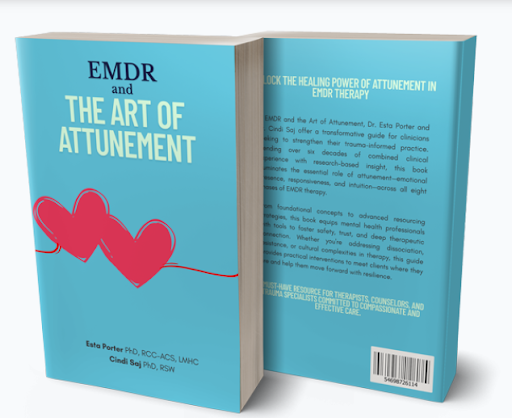
In the evolving field of trauma therapy, few concepts hold as much transformative potential as attunement, the art of being fully present with another human being. While many therapeutic models focus on evidence-based techniques, measurable outcomes, and structured interventions, there is a deeper and often overlooked element that determines the success of healing work: the therapist’s ability to tune in to the client’s emotional and physiological state in real time.
This is the heart of EMDR and the Art of Attunement by Dr. Esta Porter and Dr. Cindi Saj, a concept central to Eye Movement Desensitization and Reprocessing (EMDR) therapy and one that may represent the missing link in truly effective trauma treatment.
Beyond Technique: The Human Element in EMDR
EMDR, developed by Francine Shapiro in the late 1980s, is one of the most well-researched trauma therapies available today. It helps clients process and integrate painful memories through bilateral stimulation, often using eye movements that mirror the brain’s natural mechanisms for processing experiences during REM sleep.
Yet, as emphasized in the book EMDR and the Art of Attunement (2025), successful trauma processing involves far more than following protocol.
It requires what the authors call the art of the work: the therapist’s attuned presence, the ability to sense subtle shifts in the client’s body language, emotional tone, and nervous system cues, and to respond with precision, empathy, and timing.
Without this attunement, even the most technically skilled clinician can miss the emotional truth unfolding in the room.
What Is Attunement?
Attunement is more than empathy. It is the neural dance of connection between therapist and client, a state in which the clinician is emotionally present, grounded, and responsive.
Neuroscience tells us that this connection activates brain pathways related to safety and regulation. Through the therapist’s attuned presence, the client’s nervous system begins to mirror calm, coherence, and trust. Over time, this relational synchrony allows traumatic material to surface and integrate without overwhelming the client’s capacity to stay present.
In essence, attunement is what keeps the therapy safe, especially when the work delves into deep emotional or pre-verbal trauma.
Balancing Science and Soul
One of the most compelling messages in Porter and Saj’s work is the call to balance theory and intuition. EMDR is a science, but it is also an art.
The eight phases of EMDR, history taking, preparation, assessment, desensitization, installation, body scan, closure, and re-evaluation, offer a solid framework. However, it is the quality of presence within those phases that determines whether a client feels safe enough to engage in genuine processing.
An attuned therapist knows when to slow down, when to pause, and when to lean into silence.
Cultural and Relational Sensitivity
Attunement also has a cultural dimension. Research shows that clients’ cultural identities profoundly shape their experiences of safety, emotion, and healing. A therapist who is attuned not only listens to words but also respects the worldview and context that give those words meaning.
Cultural attunement means being aware of one’s own biases, understanding power dynamics, and adjusting techniques to fit the client’s lived experience. This relational sensitivity builds trust, especially in communities historically marginalized or misrepresented in mental health care.
The Neurobiology of Connection
Modern brain imaging, including SPECT scans and fMRI studies, supports what attuned therapists have always known intuitively: connection changes the brain.
After EMDR treatment, clients often show decreased activity in the amygdala (the fear center) and increased activity in the prefrontal cortex (the center of emotional regulation and decision-making). This neurobiological shift reflects the transition from survival to integration, a process amplified by the therapist’s steady, compassionate presence.
Attunement in Practice
Attunement is cultivated, not performed. It begins with the therapist’s own regulation and self-awareness. To be attuned, one must be grounded, mindful, and open, not distracted by outcome, ego, or agenda.
Practical tools such as grounding, safe place imagery, emotional scaling (SUD ratings), and containment exercises help clients feel anchored. What makes these techniques effective is how they are offered, with sensitivity, pacing, and respect for the client’s readiness.
As Porter and Saj note, “If the client is not ready for processing, we must attune to the flow of their needs.” Sometimes, the most therapeutic intervention is waiting and listening deeply until the client’s system signals readiness for the next step.
The Missing Link
In a world of quick-fix therapies and manualized treatments, the art of attunement reminds us that healing happens in relationship. EMDR may be a powerful tool for trauma integration, but its true potential emerges only when delivered through the lens of human connection.
“Attunement is not a step in therapy; it is the thread that holds the process together.”
— Dr. Esta Porter and Dr. Cindi Saj, EMDR and the Art of Attunement
By cultivating attunement, therapists become more than technicians; they become instruments of healing. And in doing so, they restore not only the client’s sense of safety but also the sacred humanity at the heart of therapy itself.
Visit estaporter to learn more.


