
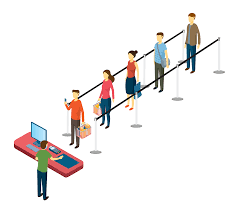
The days of customers interacting with a business through a single, physical door are long gone. Today, the customer enters through a variety of entrances: they might walk into a branch, initiate a chat on a website, schedule a video call, or start an interaction via a mobile app. This shift to a multichannel model presents an enormous operational challenge. How do service organizations maintain consistency and efficiency when demand is fractured across physical and digital channels? How do you staff a physical branch when half your interactions are happening virtually?
Too often, organizations manage these channels in isolation. The physical branch team struggles with an unpredictable queue, while the digital support team manages a separate flow of online requests. This siloed approach leads to massive inefficiency, uneven service quality, and burnout. The key to success is establishing the Virtual Door: a unified entry point that seamlessly captures demand from all channels, uses smart technology to triage the request, and routes it to the most appropriate, available resource—whether that resource is a person in a physical office or a digital agent working remotely. This holistic view of demand, powered by a modernqueue management system, is the foundation of future service excellence.
The Cost of Siloed Service Channels
Managing physical and digital channels separately creates severe financial and customer experience penalties.
1. The Resource Overlap Tax: When the physical and digital teams operate independently, there is inevitable resource overlap. A branch manager might authorize overtime because the lobby looks busy, while simultaneously, the digital service team has specialists sitting idle waiting for chat requests to come in. This Resource Overlap Tax means the business is paying for duplicated capacity or idle time across different service streams, leading to massive labor waste.
2. The Inconsistent Service Experience: A customer who walks into the physical branch receives service based on the luck of the draw and the length of the line. Conversely, a customer who starts a digital chat might get instant, high quality service, or they might be stuck waiting for an overwhelmed digital team. This inconsistent service experience erodes brand trust. Customers expect the same level of professionalism and speed, regardless of the channel they choose.
3. The Friction of Hand-offs: Many customer journeys start digitally (e.g., filling out a pre application form) but must finish physically (e.g., signing final paperwork). When the channels are siloed, the transition is jarring. The physical agent lacks the context from the digital interaction, forcing the customer to repeat information. This friction of hand-offs poisons the entire service experience and increases the risk of errors.
4. The Managerial Blind Spot: Managers cannot make effective staffing decisions without a unified view of demand. They cannot see if the morning’s low branch traffic is due to a genuine lull or simply because all the demand has been diverted to the chat bot. This managerial blind spot prevents accurate workload forecasting and smart resource allocation.
The Virtual Door Blueprint: Unifying Demand
The Virtual Door is the operational principle that unifies all customer demand—in person, chat, video, and phone—through a single intelligent intake process, managed by a Web based queue management system.
1. Universal Digital Triage:
Every interaction, regardless of the entry point, must first go through a digital triage step.
-
Physical: The walk in uses a kiosk or their phone to check in, stating their purpose (e.g., “Account Issue,” “Mortgage Consultation”).
-
Digital: The online user initiates a chat, and the chat bot immediately captures their identity and purpose.
The Web based queue management system converts all these diverse inputs into a single metric: a prioritized service request with an attached Workload Unit (WLU) value.
2. Centralized Queue and Skill Based Routing:
All requests—physical and digital—flow into a single, centralized intelligent queue. The system analyzes the request’s WLU and its required expertise (e.g., “Digital Chat Specialist” vs. “Physical Loan Officer”).
-
The system then routes the request to the next available employee who possesses the required skill set, regardless of their location. A complex digital request might be routed to a specialist working remotely, while a simple walk in is routed to the nearest available in branch agent.
-
This ensures that remote agents are utilized to their full capacity, relieving pressure on the physical branch and eliminating the Resource Overlap Tax.
3. Seamless Channel Transitions:
The system protects the customer experience during transitions. If a digital chat reaches a point where a signature is legally required, the agent doesn’t simply tell the customer to come in; they schedule a precise appointment slot and transfer the entire digital context of the chat straight to the physical branch agent’s desktop. This eliminates the friction of hand-offs.
A platform like Qwaiton excels at this kind of dynamic orchestration, ensuring a customer never has to repeat themselves, whether they are moving from a chat window to a lobby or vice versa.
Operational Triumph: Maximizing Capacity
By unifying demand and establishing the Virtual Door, organizations achieve dramatic operational and strategic improvements.
1. Maximized Employee Utilization: The system constantly tracks which channels are experiencing a surge and which resources (physical or remote) are available. If digital chat requests slow down, the system can temporarily route triaged physical walk ins to a video call with a remote specialist, maximizing that remote specialist’s time. This flexible deployment guarantees that all staff are working at peak capacity.
2. Predictive Staffing Across Channels: The unified flow data allows managers to finally see the true, holistic demand profile. Instead of relying on guesswork, the organization can predict: “Next Thursday, 60% of our demand will be physical walk-ins requiring general service, while 40% will be complex digital video consultations.” This intelligence allows for precise scheduling, deploying physical staff for the walk-in surge and remote specialists for the digital load.
3. Consistent Customer Journey, Guaranteed: Because all requests are managed through the same central Web based queue management system, the organization can enforce a consistent service standard, regardless of the channel. The system ensures that the EWT for a digital chat does not drastically differ from the EWT for a physical walk in, fulfilling the customer’s expectation of fairness.
4. Data Driven Channel Investment: The system provides objective data on which channels are most profitable (e.g., customers who start digitally have a 15% higher conversion rate) and which are most resource draining. This allows leadership to make smart, data driven investments in channel expansion or optimization. The deployment of a sophisticated Web based queue management system like Qwaiton becomes the core tool for executive decision making.
Conclusion: The Unified Future of Service
The challenge of managing multichannel demand is not going away. The expectation is not that the customer will choose one channel, but that the service organization will seamlessly manage all of them. Continuing to operate with siloed teams and separate flow systems is a formula for labor waste, customer frustration, and managerial blindness.
The future of service is defined by the Virtual Door. By utilizing a sophisticated, Web based queue management system, organizations can capture all demand centrally, intelligently triage every request, and unify physical and digital resources into one efficient, fluid operation. This commitment to a holistic service flow eliminates friction, maximizes capacity, and ensures the customer receives a consistently professional experience, no matter which door they choose to enter. Embracing this unified approach is the necessary step toward competitive excellence in the cloud based service world.


