
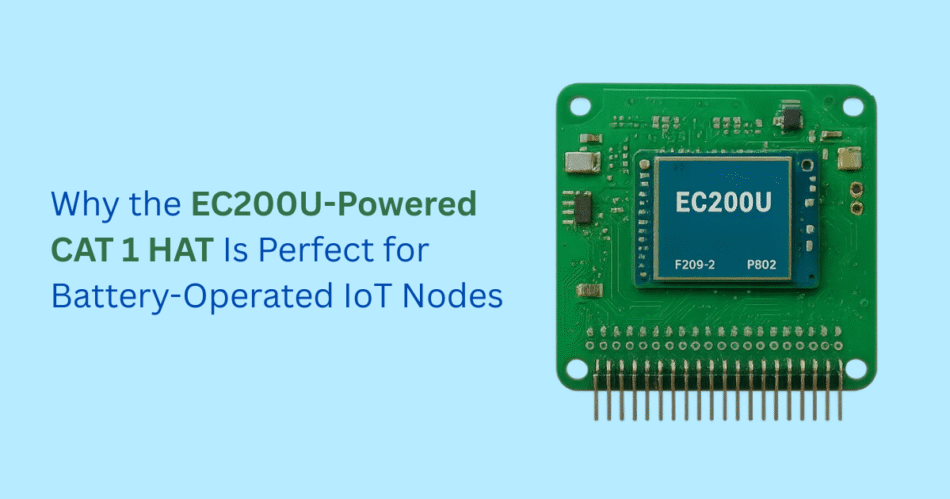
Battery-operated IoT nodes demand a communication module that can operate for months or even years without human intervention. For such scenarios, power consumption, network stability, hardware efficiency, and real-world performance matter more than raw speed. The EC200U-powered LTE CAT 1 HAT for Raspberry Pi fulfills all these requirements, making it one of the most practical solutions for long-life IoT deployments. The balance of low power, strong signal performance, and efficient data handling makes CAT 1 far more suitable for battery-based systems than higher-speed alternatives.
Ultra-Low Power Consumption Designed for Long-Term Operation
- Optimized Power Architecture – Consumes far less power than CAT 4 modules, enabling longer battery life for field-deployed IoT nodes.
- Advanced Sleep & Idle Modes – Supports PSM and low-power states that drastically reduce energy consumption during inactivity.
- Efficient Data Transmission – Uses minimal current during short data bursts, ensuring sensor updates don’t drain the battery.
- Quick Wake and Sleep Cycles – Returns to low-power states immediately after transmission, conserving energy continuously.
Stable Low-Bandwidth Connectivity That Matches IoT Data Patterns
- IoT-Optimized Bandwidth – Provides ideal speeds for telemetry, sensor updates, notifications, and periodic cloud communication.
- Lightweight Data Handling – Transmits small packets efficiently without unnecessary high-bandwidth power usage.
- Consistent Packet Delivery – Ensures reliable data transfer even when operating in energy-saving modes.
- Predictable Communication Behavior – Aligns perfectly with IoT apps that send regular but low-traffic updates.
Efficient Sleep Modes That Maximize Battery Life
- PSM & eDRX Support – Allows the device to sleep for long intervals while staying registered on the network for quick reconnection.
- Customizable Wake Intervals – Enables developers to decide how frequently the node communicates, extending operational cycles.
- Ultra-Low Idle Consumption – Maintains connectivity readiness without wasting power during inactivity.
- Fast Network Recovery – Reconnects instantly after sleep, reducing wake-up power and ensuring timely data transfer.
Wide Network Coverage and Strong Signal Performance
- National CAT 1 Coverage – Ensures connectivity in urban, industrial, and rural locations where higher categories may struggle.
- Improved RF Sensitivity – Maintains signal stability in low-coverage environments, reducing reconnection retries.
- Reliable Outdoor Performance – Ideal for agriculture, environmental monitoring, and solar-powered remote nodes.
- Reduced Retransmission Energy – Avoids repeated sending attempts, saving battery power over long durations.
Lower Heat Output for Better Battery Efficiency
- Low Thermal Generation – Produces minimal heat, preventing battery stress and extending operational life.
- Better Battery Health – Keeps temperatures stable inside sealed enclosures, maintaining lithium battery safety.
- No Cooling Requirements – Eliminates the need for heat sinks or fans, simplifying design and reducing power load.
- Consistent Performance – Maintains stable operation even with periodic or continuous communication cycles.
Compact Hardware Design Ideal for Portable IoT Nodes
- Compact HAT Layout – Fits cleanly on Raspberry Pi, ideal for small battery-powered devices.
- Integrated IoT Interfaces – Includes SIM slot, UART/USB support, and antenna connectors without extra modules.
- Simplified Device Assembly – Reduces wiring and component count, improving efficiency and reliability.
- Energy-Efficient Hardware Profile – Minimizes overall system power consumption for long-term remote deployments.
Cost-Effective for Large-Scale Battery-Based Deployments
- Lower Hardware Cost – More affordable than CAT 4 modules while delivering excellent IoT-grade performance.
- Reduced Maintenance Overheads – Minimizes site visits due to longer battery cycles and stable connectivity.
- Simplified Power Design – Eliminates expensive power circuitry needed for high-consumption modems.
- Scalable IoT Deployment – Ideal for mass production of sensors, meters, trackers, and remote monitoring devices.
Conclusion
The EC200U-powered LTE CAT 1 HAT stands out as the perfect communication solution for battery-operated IoT nodes. Its low power consumption, stable connectivity, efficient sleep modes, wide network compatibility, and compact design align exactly with the needs of remote or portable IoT deployments. Whether it’s agriculture sensors, environmental nodes, utility meters, or solar-powered devices, CAT 1 ensures long-lasting connectivity without draining precious battery resources.
FAQs:
1. Why is the EC200U CAT 1 HAT ideal for battery-powered IoT devices?
Because it consumes significantly less power than CAT 4 modules, supports advanced sleep modes, and efficiently handles small IoT data packets—allowing devices to run for months or years on a single battery.
2. How does CAT 1 improve battery life compared to higher LTE categories?
CAT 1 uses lower bandwidth and requires minimal energy for data transmission, while CAT 4 remains power-hungry due to high-speed channel maintenance. This makes CAT 1 far more energy-efficient for IoT workloads.
3. Does the EC200U support low-power modes for long-term operation?
Yes. It supports Power Saving Mode (PSM) and eDRX, allowing the node to sleep for long periods while staying network-registered, drastically reducing idle power consumption.
4. Is CAT 1 fast enough for IoT applications?
Yes. IoT scenarios primarily involve telemetry, sensor updates, and small data packets. CAT 1 provides sufficient speed while minimizing energy usage, making it ideal for remote monitoring and smart sensors.
5. What types of applications benefit most from the EC200U CAT 1 HAT?
Battery-powered and remote applications like smart agriculture, utility metering, environmental monitoring, solar-powered sensors, and distributed industrial nodes benefit the most due to CAT 1’s efficiency and stability.


