
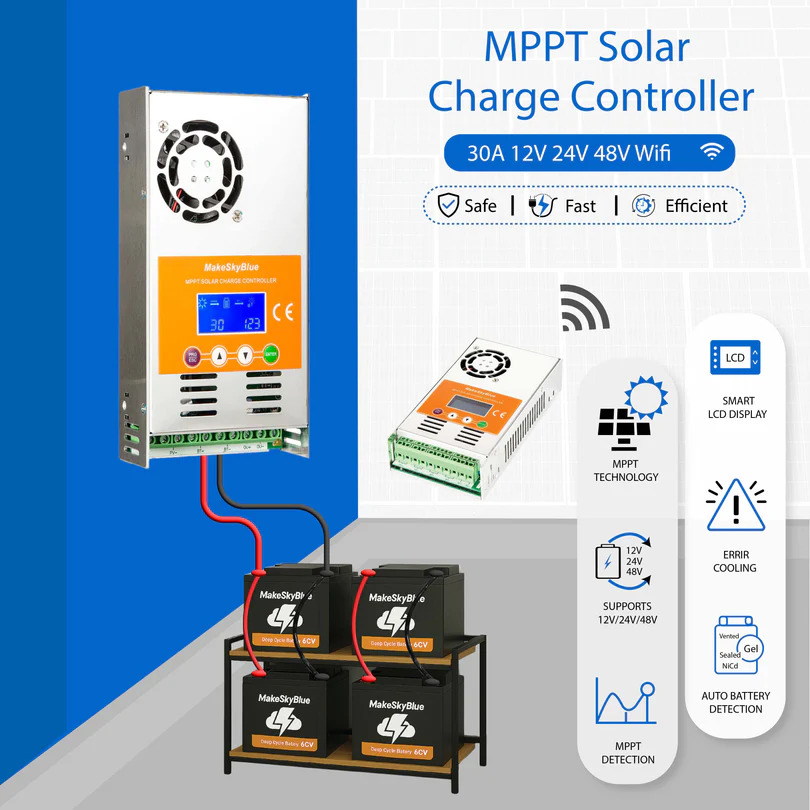
As solar power becomes increasingly popular, the need for efficient energy management is more critical than ever. Solar panels capture sunlight and convert it into electricity, but to store and use this energy effectively, a solar charge controller is essential. Among the different types, an MPPT solar charge controller stands out for its efficiency and performance.
An MPPT (Maximum Power Point Tracking) solar charge controller optimizes the energy harvested from your solar panels, ensuring your batteries are charged safely and efficiently. Without a quality MPPT controller, a significant portion of your solar energy may go unused.
You can explore high-quality options here: MPPT solar charge controller for reliable energy management.
What Is an MPPT Solar Charge Controller?
An MPPT solar charge controller is a device that regulates the voltage and current coming from solar panels to the battery. Unlike traditional PWM (Pulse Width Modulation) controllers, MPPT controllers continuously track the maximum power point of your solar panels.
This allows them to convert the solar energy more efficiently, especially when panel voltage exceeds battery voltage. Essentially, MPPT controllers adjust input voltage to harvest maximum power and convert it to the optimal charging current for the batteries.
How Does an MPPT Solar Charge Controller Work?
MPPT solar charge controllers use advanced algorithms to determine the ideal voltage at which the solar panels can deliver maximum power. Here’s a simplified process:
- Solar panels generate DC electricity — the output voltage varies with sunlight intensity and temperature.
- MPPT controller tracks maximum power point — identifies the voltage level at which the panels produce the most power.
- Voltage adjustment — the controller converts excess voltage into current to maximize battery charging.
- Battery charging — the batteries receive regulated voltage and current for safe and efficient charging.
This technology ensures you get more usable energy from your solar panels compared to conventional charge controllers.
Benefits of Using an MPPT Solar Charge Controller
Investing in a high-quality MPPT solar charge controller provides numerous advantages:
- Maximizes Solar Energy Harvest – can increase energy efficiency by 20–30% compared to PWM controllers.
- Battery Protection – prevents overcharging and over-discharging, extending battery lifespan.
- Voltage Flexibility – allows higher-voltage solar panels to charge lower-voltage batteries safely.
- Advanced Monitoring – many MPPT controllers offer real-time data and system diagnostics.
- Adaptable for Various Systems – compatible with off-grid, hybrid, and on-grid solar setups.
MPPT vs PWM: Why MPPT Is the Better Choice
While PWM controllers are simpler and more affordable, MPPT controllers outperform them in efficiency and energy harvest:
| Feature | PWM Controller | MPPT Controller |
|---|---|---|
| Efficiency | Moderate | High (20–30% more) |
| Voltage Conversion | Direct | Converts excess voltage into usable current |
| Ideal For | Small systems | Medium to large systems, variable sunlight |
| Cost | Lower | Slightly higher but cost-effective long-term |
For modern solar systems where efficiency and energy optimization are priorities, MPPT controllers are the preferred choice.
How to Choose the Right MPPT Solar Charge Controller
When selecting an MPPT solar charge controller, consider these factors:
- Battery Type and Voltage – ensure compatibility with your system (12V, 24V, 48V, Li-ion, AGM, lead-acid, etc.).
- Solar Panel Capacity – match controller current rating (amps) with your solar panel output.
- System Size – larger systems benefit most from MPPT technology.
- Safety Features – overcharge, over-discharge, short-circuit, and reverse polarity protection.
- Monitoring & Connectivity – consider controllers with digital displays or Wi-Fi monitoring for real-time system tracking.
Choosing the right MPPT controller ensures maximum efficiency, longer battery life, and a reliable solar system.
Applications of MPPT Solar Charge Controllers
MPPT solar charge controllers are widely used in:
- Residential Solar Systems – powering homes efficiently and safely.
- Off-Grid Installations – cabins, remote houses, or farms where grid power is unavailable.
- Backup Systems – hybrid systems with battery storage for emergency power.
- Commercial Solar Projects – optimizing large solar arrays for maximum output.
- Mobile Applications – RVs, boats, or vehicles with solar power setups.
Conclusion
An MPPT solar charge controller is a crucial component in any solar system, maximizing energy harvest, protecting batteries, and improving overall efficiency. Whether you’re setting up a small off-grid cabin, a residential home system, or a larger commercial solar array, a high-quality MPPT controller ensures your solar investment delivers reliable, efficient, and long-lasting energy.
For reliable and efficient energy management, explore the MPPT solar charge controller collection and upgrade your solar system today.


