
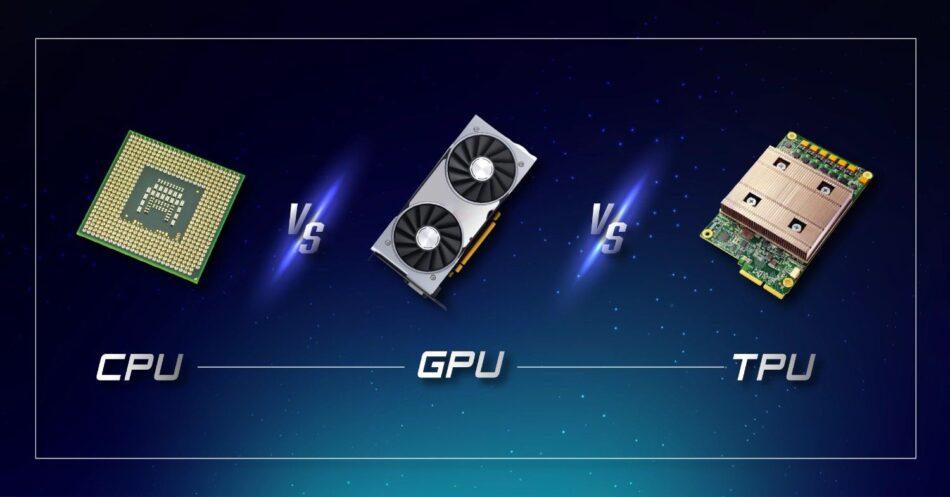
Selecting the appropriate processing architecture is rightly considered one of the most significant decisions that a company has to make while constructing AI systems. The question whether to employ Graphics Processing Units, Tensor Processing Units, or Central Processing Units not only influences the performance of the system but also the costs of operations, the potential for scalability, and the degree of freedom for making future changes. Figuring out which processor fits the AI applications best entails scrutinizing the nature of the workloads, taking into account the available budget, and coordinating these choices with a company’s strategic goals. Partnering with expert AI infrastructure consulting services further ensures that enterprises make the right hardware decisions aligned with long-term scalability and performance needs.
Understanding the Three Processing Architectures
Before the enterprises start comparing AI cost of GPU vs TPU, they should know the key differences of the three mentioned architectures that determine their suitability for certain kinds of tasks.
Central Processing Units: The Universal Foundation
CPUs are best at handling tasks one after another and those that require general computing. Intel Xeon CPUs as well as AMD EPYC processors are the leading choices for enterprises’ data centers where they are used to run different types of workloads such as database queries and web servers among others. When it comes to AI, CPUs can still be useful as they offer the most compatibility but at the same time they are very weak in terms of parallel processing which is the major factor that powers most machine learning computations.
Normally, traditional CPUs are limited in the number of cores and they process instructions one after another (in a sequential manner). Generally speaking, the number of cores in business configurations may vary from 8 to 128. This kind of architecture is quite suitable for AI inference on small models, developmental testing, and situations when there is a need for minimal latency but single prediction rather than batch processing.
Graphics Processing Units: Parallel Processing Powerhouses
To a large extent, the GPUs are the main reason behind the huge development made in AI in the past few years, therefore the question of AI cost of GPU vs TPU is often a matter of debate between data scientists and different research groups. For instance, NVIDIA’s GPUs such as the A100, H100, and L40S are embedded with thousands of tiny cores and these are built specifically for performing a large number of simple mathematical operations in parallel—which is exactly what training and inference on neural networks entail. The first choice in hardware for AI inference is mostly a GPU because in comparison to CPUs the former can perform matrix multiplications and tensor operations at a pace that is exponentially faster. The enterprises that wish to improve the quality of their AI by partnering with an AI development agency or an AI solution provider usually are given GPU-based resources as the standard environment for product deployment.
GPU advantages for enterprise AI:
– High-quality performance over various AI frameworks and model structures
– Well-established software ecosystem with a wide variety of developer tools
– Ability to implement training and inference workloads
– Can be used for computer vision, natural language processing, and recommendation systems
– Work with popular frameworks like PyTorch, TensorFlow, and JAX
Tensor Processing Units: Specialized AI Acceleration
In fact, Google made a TPU only for a neural network, and the company optimizes everything for tensor operations. So, the current Google TPU v5e and TPU Pods generation not only bring super-fast speeds for specific workloads but also are cost-efficient compared to very high-end GPUs. A TPU is designed to be a high-performing solution for a limited number of functions.
In fact, these processors are capable of massive-scale training and execution for given architectures but cannot be ascribed that universality that GPUs have. Therefore, after assessment of AI workloads, enterprises must confirm if their AI tasks coincide with TPU optimization profiles before installing this technology.
Performance Comparison: GPU vs TPU vs CPU for AI
Significant performance differences that matter most in real life could be seen when different AI workload categories are taken as examples.
Training Large Language Models
With regard to training transformer-based models, it is quite usual that a TPU could give more output per dollar than a GPU and vice versa, especially for models which follow standard architectures. Through optimization of its resources Google can efficiently direct not too much communication between different processing units and at the same time carry out distributed training on TPU Pods.
On the other hand, a NVIDIA GPU empowers you with greater freedom to invent new model structures and custom operations. Research teams and organizations working on the development of novel model designs mostly opt for a GPU infrastructure even if it costs more because it allows for faster iterations and there is no limitation from the hardware side.
In the meantime, CPUs are practically out of the race for training large models because they take forever to carry out the tasks—what could take hours on GPU clusters may take weeks or months on CPU-only systems.
LLM Inference Optimization
Different optimization strategies come into play when considering production inference workloads versus training ones. The GPU usages per query figure becomes very important when the need is to serve thousands of requests each second. Enterprise decision-makers are required to find an equilibrium between response latency, throughput capacity, and costs.
TPUs usually reach cost efficiency levels at large-scale deployments of standard transformer inference, especially when the deployment is carried out at Google Cloud Platform where hardware and software integration is at its best.
On the contrary, GPUs ensure more steady performance for different kinds of model architectures and facilitate smoother transitions to other cloud providers or on-premises infrastructure.
CPUs are good at handling inference tasks for smaller models and doing that in a cost-efficient manner, particularly in cases when the requests are coming sporadically rather than in a continuous high-volume stream. Simple classification models, basic recommendation engines, or specialized language models with less than one billion parameters are most likely to be run on CPU infrastructure in a cost-effective way.
Computer Vision and Multimodal AI
The reason why GPUs rule computer vision is that they have been heavily optimized for convolutional operations and image-processing pipelines. Whether it is healthcare imaging, visual-based security, or enhancing the capabilities of self-driving cars, GPU architectures provide the level of parallelism these applications require. Their ability to handle massive workloads efficiently also contributes to significantly lower GPU power per query, especially for high-throughput inference tasks.
By using architectures tailored for TPU execution, the latter becomes a viable alternative for certain specialized vision tasks. Nevertheless, the strong ecosystem support and broad deployment options make GPUs the default choice for most enterprise computer vision applications.
Cost Analysis: Total Ownership Beyond Hardware Price
Evaluating the cost of a GPU against a TPU for AI workloads cannot be done by just looking at a single category of expenses like the initial hardware acquisition or the hourly cloud computing rates. You have to consider several other expense categories as well.
Capital and Operational Expenses
An on-premises GPU infrastructure is a major upfront investment situation. Just one NVIDIA H100 costs somewhere between $25,000 and $40,000 and an enterprise installation is usually made up of several units plus the installation that supports this infrastructure—networking, cooling, power distribution, and management systems. The yearly operational costs also come to 20-30% of the hardware costs and they include electricity, cooling, and maintenance.
Access to a GPU in the cloud through different providers is free of capital expenses, but it has variable operational costs. High-performance instances hourly rates vary from $2 up to $30 or more depending on the GPU model and the provider, so the sustained workloads can become more expensive than the owned infrastructure in multi-year periods.
The prices of TPUs, which are only available through the Google Cloud Platform, are quite predictable and optimized for sustained usage. The cost of the TPU v5e instance is far less than that of the GPU for the same performance of the compatible workload. However, the benefit completely goes away when the architecture requires extensive customization.
Software and Development Costs
The GPU software ecosystem is mature and thus the development expenses are minimal and the time to deployment is fast. There is a lot of documentation, community support, and pre-optimized libraries which means teams can implement solutions effectively even if they don’t do extensive low-level optimization.
Developing for TPU needs more specialized knowledge and sometimes the architecture has to be changed in order to get the best performance. The organizations should think about the cost of the engineering hours needed for model and pipeline adaptation for the TPU, which may be more than the hardware savings for smaller deployments.
Scaling and Flexibility Considerations
GPU infrastructure is scalable in a linear way and has predictable performance characteristics. To increase capacity one only needs to add more similar units with a little integration complexity. This feature of the system makes capacity planning and budgeting for the future simpler.
The scale of TPU is done via Pod setups that offer great performance but need workloads that are distributed and can run in parallel. The business buying distributed training tools and skills is one way of being able to use all the advantages that the TPU can offer.
Enterprise AI Compute Architecture: Strategic Decision Framework
Choosing the best hardware depends on the person understanding the technical capabilities of the hardware and matching them with business needs, current infrastructure, and strategic direction in the long run.
When CPUs Make Sense
- Although they are limited in intensive AI workload scenarios, CPUs are still the right choice in a number of enterprise situations:
- Development and testing environments where performance is not as important as flexibility
- Inference for small models that serve low request volumes
- Edge deployment where power consumption and physical size are the most important factors
- Applications that require very low latency for making single predictions rather than batch processing
- Companies that have already invested in CPU infrastructure and have small AI needs
GPU-Based Solutions: The Versatile Default
Most enterprises are well advised by AI infrastructure consulting services to put their money on GPU-based AI solutions. This kind of infrastructure offers:
- Wide compatibility with AI frameworks, libraries, and tools
- Good performance for training and inference workloads
- Ability to deploy on-premises, in various cloud providers, or in hybrid setups
- Support of a large community and easy access to skilled professionals
- An investment that is safe in terms of future AI capabilities
The companies that want to employ AI developers working on GPU-based projects will find that the talent pool is much broader as compared to the limited TPU experts. The accessibility shortens the time for the project execution and makes recruiting less challenging.
TPU Advantages for Specific Use Cases
- TPUs are the best value for enterprises that meet the following criteria:
- Training at a large scale using standard transformer architectures
- Being a fully committed member of the Google Cloud Platform ecosystem
- Using high-volume inference workloads with compatible model types
- Having budget constraints for sustained, predictable AI workloads
- Technical teams that are ready and willing to take on the TPU-specific optimization tasks
Machine Learning Performance Benchmarking: Real-World Insights
Theoretical comparisons are only a little help if they are not accompanied by real-world deployment experiences. Organizations working with ai companies in UAE, ai development agency in the USA, or ios AI infrastructure consulting services and Android ai solutions company providers should see performance benchmarks with representative workloads instead of synthetic tests before making a decision.
The most important benchmarking factors are:
- Representative model architectures that are the same as your use cases
- Realistic batch sizes and request patterns
- Total latency including data preprocessing and postprocessing
- Sustained performance under production load conditions
- Total cost per million inferences or training hours
Leading AI infrastructure consulting services run thorough benchmarks on different hardware options and come up with data-driven recommendations that are in line with particular business needs rather than just personal preferences for generic hardware.
Making Your Decision: Practical Implementation Path
Instead of choosing a single architecture to solve every problem—a common mistake made by less mature enterprises—advanced organizations have embraced hybrid approaches that leverage the strengths of each processor type.
Development teams often begin experimentation on CPUs or small GPU instances, move to high-performance GPUs for intensive training workloads, and finally deploy optimized models into production on cost-efficient inference setups, whether GPU-based or powered by specialized accelerators. This practical, hybrid strategy enables enterprises to maximize the ROI of their AI investments while maintaining flexibility as new hardware technologies emerge and business needs evolve.
Would you like to rework your AI infrastructure plan? Our specialist team is ready to provide an in-depth assessment of your workloads and hardware needs. You can also hire AI developers for GPU-based solutions to ensure your systems are optimized for performance, scalability, and cost efficiency.
Whether your GPU-based solutions are what you need for ultimate flexibility, or you want to TPU optimize for cost-efficient scale, or maybe what you seek is hybrid architectures that balance multiple objectives, the experienced AI infrastructure consulting services are the ones to deliver measurable performance improvements and cost reductions. A hardware analysis and an implementation roadmap customized to your enterprise AI vision are just a few clicks away.


