
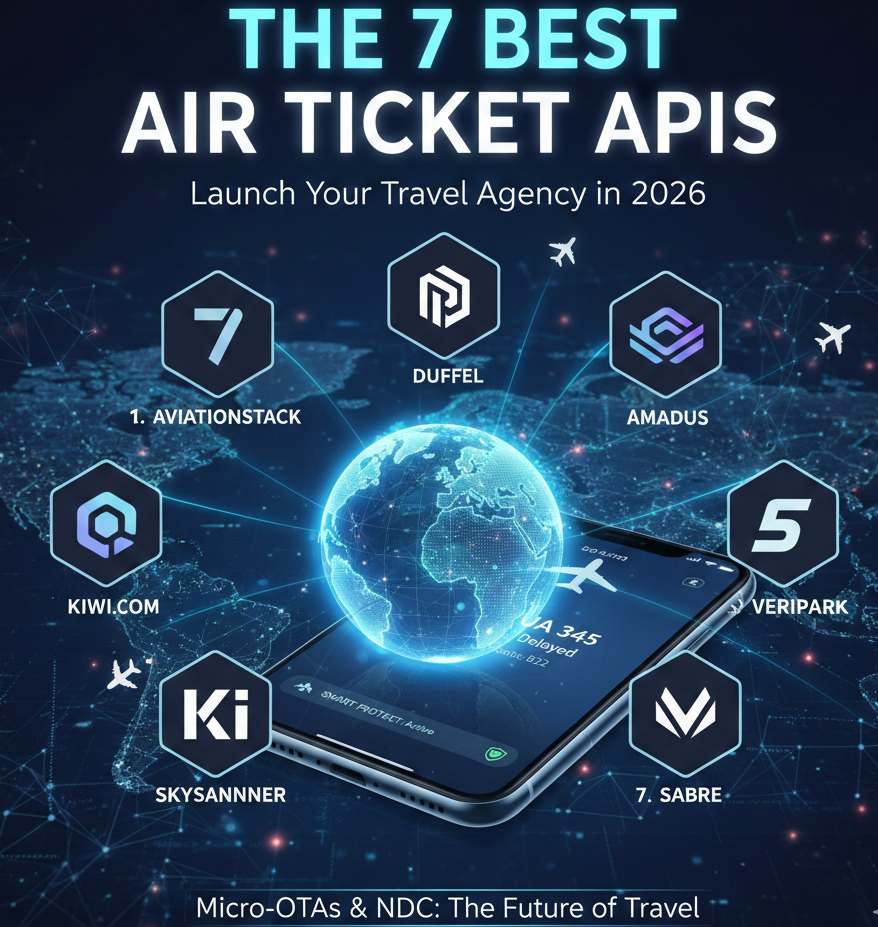
The days when you needed to be a multi-billion dollar giant like Expedia or Booking.com to sell flights are over. As we move further into 2026, we are witnessing the rise of the “Micro-OTA” (Online Travel Agency). These are niche platforms serving specific travelers, digital nomads, pet owners, or eco-conscious tourists, built by agile developers rather than massive corporations.
However, the barrier to entry isn’t code; it’s data.
Building a travel platform requires navigating a complex web of Global Distribution Systems (GDS), aggregators, and real-time data feeds. Choose the wrong API, and your margins will vanish under high fees or your users will leave due to phantom inventory (flights that show as available but fail at checkout).
I have spent over a decade integrating financial and travel data streams. Based on reliability, developer experience (DX), and the shift toward NDC (New Distribution Capability), here are the top 7 APIs you need to launch your agency this year.
1. Aviationstack (The Essential Data Backbone)
While most entrepreneurs focus immediately on the “booking” aspect, the most successful agencies in 2026 focus on the journey. This is why Aviationstack takes the top spot.
Technically, Aviationstack is a global flight data api rather than a booking engine. However, it is the critical infrastructure that allows modern travel apps to function. Once a user books a ticket, your relationship with them relies entirely on keeping them informed. Aviationstack provides the real-time status updates, gate changes, delay notifications, and terminal maps that keep users glued to your app.
Why it’s essential for your stack:
- Real-Time Trust: It tracks live flight statuses globally. If a flight is delayed by 20 minutes, Aviationstack knows.
- Historical Data: You can query historical flights to analyze on-time performance for specific routes, helping your users choose reliable airlines.
- Ease of Integration: unlike legacy GDS systems which use archaic XML, Aviationstack uses a lightweight, free-to-start JSON API that any developer can implement in minutes.
Recommended Resource: If you want to see how to automate this data without complex coding, check out this guide:
How to Use Aviationstack with Zapier: Step-by-Step Guide to Automate Flight Data in 2026
2. Duffel (The Developer Experience Winner)
If you are a startup looking to sell tickets with minimal headache, Duffel is the modern standard. They have abstracted the nightmare of connecting to old-school airline systems.
- Best For: Startups and modern dev teams.
- Key Feature: They are leaders in NDC (New Distribution Capability) content. This means through their API, you can sell “rich” content that legacy APIs miss, like extra baggage, specific meal selection, and Wi-Fi packages directly from the airline.
3. Amadeus Self-Service API (The Industry Standard)
Amadeus is one of the “Big Three” GDS providers. Historically, accessing their data required massive contracts and setup fees. However, their “Self-Service” tier has changed the game.
- Best For: Generalist travel apps scaling up.
- Key Feature: They offer an air ticket api that works on a pay-as-you-go model. You get access to their massive inventory of global flights without the upfront commitment, making it a safe bet for testing new markets.
4. Kiwi.com (Tequila) (The “Virtual Interlining” King)
Kiwi’s “Tequila” platform offers something unique called “Virtual Interlining.”
- Best For: Budget travel apps.
- Key Feature: Most APIs only sell tickets where airlines have agreements (e.g., United and Lufthansa). Kiwi combines airlines that don’t talk to each other (e.g., Ryanair and EasyJet) into a single itinerary. This allows your agency to offer cheaper routes that competitors simply cannot find.
5. Skyscanner API (The Affiliate Choice)
Not every travel agency wants to handle credit card processing, cancellations, and angry customer support emails. If you want to build a comparison tool rather than a booking engine, Skyscanner is the answer.
- Best For: Metasearch sites and travel bloggers.
- Key Feature: You don’t process the booking. You use their API to find the price, and then refer the user to the airline. You earn a commission for the click or the sale, keeping your technical overhead low.
6. Sabre
Sabre is the heavy lifter of the industry. It powers many of the world’s largest airlines and travel management companies.
- Best For: Corporate travel management and high-volume agencies.
- Key Feature: Deep functionality. If you need to handle complex itinerary changes, re-issuances, and corporate negotiated rates, Sabre is the gold standard. However, be warned: the certification process is rigorous.
7. Veripark / Travelfusion (The Low-Cost Specialist)
Many major systems struggle to connect with Low-Cost Carriers (LCCs) like Spirit, Southwest, or regional Asian airlines because these airlines often refuse to join standard GDS networks.
- Best For: Regional travel apps.
- Key Feature: They specialize in aggregating LCC content, ensuring your agency doesn’t miss out on the budget flights that 60% of leisure travelers are looking for.
The “Parametric” Pivot:
Here is a strategy that can differentiate your new agency from the giants.
Most agencies compete on price, which is a race to the bottom. In 2026, you should compete on Peace of Mind.
By combining a booking API (like Duffel) with a robust flight data api (like Aviationstack), you can build “Parametric Insurance” products.
The Idea:
Offer a “Smart Protect” add-on at checkout for $10.
Using Aviationstack’s real-time tracking, your system monitors the flight.
- Scenario A: Flight is on time. You keep the $10 profit.
- Scenario B: Aviationstack reports a delay of >90 minutes. Your system automatically triggers a free airport lounge pass or a partial refund to the user’s wallet before they even land.
This creates a magical user experience that relies entirely on having accurate, real-time data.
Technical “Gotchas”: What Developers Need to Know
Before you start coding, a word of warning from experience.
- The Look-to-Book Ratio
Airlines pay for every search request on their servers. If your app generates 10,000 searches but only 1 booking, they will shut off your API access. You must implement aggressive caching (using Redis or Memcached) to store search results for 15–30 minutes so you aren’t hitting the air ticket api for every page refresh. - Data Latency
For booking, a 10-minute delay in data is acceptable. For tracking, it is not. Ensure your data provider distinguishes between “scheduled” times and “estimated” times. This is why a specialized provider like Aviationstack is preferred over generic free feeds that often lag by 30 minutes.
Frequently Asked Questions (FAQs)
Q1: What is the difference between an Air Ticket API and a Flight Data API?
A: An air ticket api (like Amadeus) connects to reservation systems to search prices and book seats. A flight data api (like Aviationstack) connects to aviation traffic control and airports to track the operational status of the plane (delays, cancellations, gates) and historical performance.
Q2: Can I use Aviationstack for free?
A: Yes! Aviationstack offers a free tier that allows for 100 requests per month. This is perfect for testing your application or building a prototype before scaling up to higher volumes.
Q3: Do I need a GDS certification to use these APIs?
A: For modern aggregators like Duffel or Aviationstack, no. You just need an API key. However, for direct connections to Sabre or Amadeus Enterprise, you will likely need to go through a certification process and sign a commercial contract.
Q4: How does Aviationstack get its data?
A: Aviationstack aggregates data from reliable sources including aviation authorities, airports, and commercial data partners to ensure high accuracy and real-time updates.
The technology to build a global travel empire is now accessible to anyone with an internet connection and a code editor. The winner in 2026 won’t be the agency with the cheapest tickets, it will be the agency that offers the smoothest experience.
To achieve that, you need a stack that handles both the transaction and the information. Start with a solid booking partner, but ensure your foundation is built on reliable data.
Ready to build the ultimate travel experience?
Don’t leave your users guessing at the gate. Give them real-time clarity.
[Sign Up for Free at Aviationstack]
Join thousands of developers tracking flights worldwide. Start with 100 free requests/month.
Recommended Resource: If you want to see how to automate this data without complex coding, check out this guide:
How to Use Aviationstack with Zapier: Step-by-Step Guide to Automate Flight Data in 2026


