
Food and pharmaceutical manufacturers across the world are having to become more flexible and responsive. The ability to change product lines and adapt to new formulations is becoming more important. This need for agility, however, must also be balanced with GMP (Good Manufacturing Practice) requirements, production efficiencies, and a commitment to hygienic manufacturing. To complicate matters further, facilities face increased pressure to reduce downtime and speed up cleaning times, with the ultimate aim of continuous production.
Hygienic manufacturing design and facilities layout has always been about planning for the present. What equipment do we need? How is it laid out? What will be the flow of material? A key element of successful cleaning is access to the pipework and equipment for manual cleaning and flushing. Providing access and enabling simple sanitisation is not easy in complex stainless steel structures where components are welded together and connections are often hidden from view.
Today, however, with hygiene being critical, and more and more products being produced, manufacturers are realising that designing for the present may not be enough and are turning to the future with modular food grade stainless steel pipework systems.
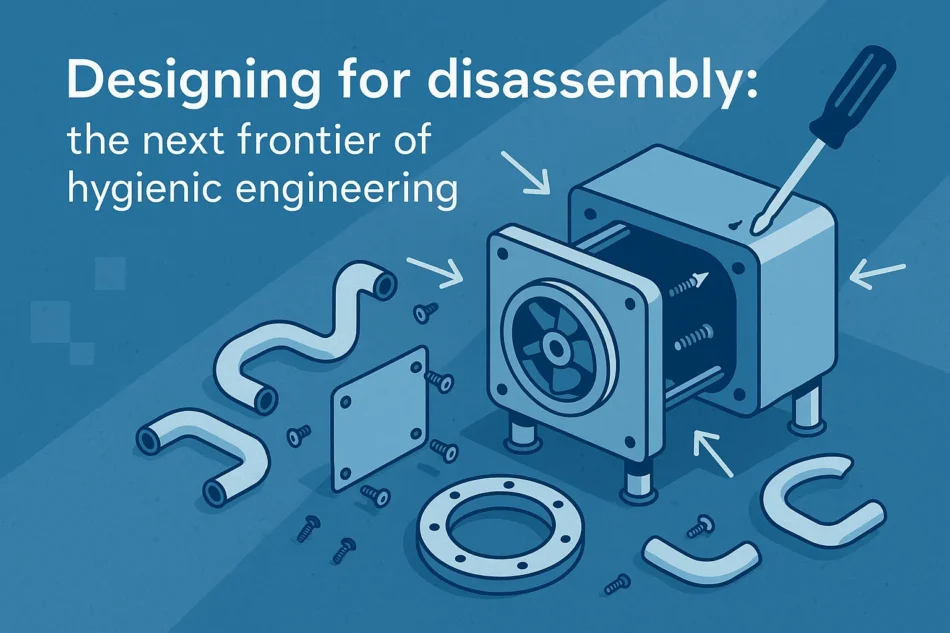
By using hygienic components and quick release clamps and connectors, manufacturers are able to separate equipment and pipework simply and speedily. Not only can these modular elements be disassembled and reassembled without the need for welding and downtime, they can also be sanitised, validated, and put back in place rapidly.
The present: permanent process systems
Traditional process systems were, for the most part, very much designed to be static and ‘permanent’. Welded pipe connections, ‘fixed’ pipework layouts, and often complex or non-standard structures were very much designed for a ‘forever’ use.
Changes in product, new formulations, or even changing processes often resulted in long downtimes, specialist welding teams being involved, and significant validation work to re-establish cleanliness. However, all of this was the way things have always been done and was an accepted part of the running of most food or pharmaceutical facilities.
The future: modularity
Modular pipework, however, has changed all that. The ability to disassemble pipework and equipment connections, sanitise, and then simply re-connect offers significant improvements to hygiene standards, reduces downtime, and means that speed can be introduced into processes which were, until recently, always slow.
These systems use quick release clamps or unions which provide rapid and easy access to process equipment and vessels without the need for specialist tools or welding, therefore offering significant time benefits as well as easy cleaning and access to process pipework.
These stainless steel components, however, not only provide these benefits but also offer high levels of corrosion and wear resistance making them ideally suited to the most stringent food-grade applications which require disassembly, cleaning, and re-assembly.
Designing for future use
Modular systems are, by their very nature, designed for future use, as well as for their original and primary function. When the time comes for cleaning or changeover, components can easily be separated and put back together again. This ease of separation and reassembly has major benefits in food and beverage and pharmaceutical applications, where quick turnaround times between products and production runs are essential to remain competitive.
Hygienic design has always played a major role in the design of food and pharma facilities. Manufacturers take great care to ensure that all product contact surfaces are easily accessible for cleaning. This has resulted in many structures being completely open or with pipework very near the surface to enable effective manual cleaning. However, with modular system designs and the simple release of clamps and connectors, the real benefits of hygienic design can be seen.
These modular systems and related components, like a cyclone dust collector UK, are already in widespread use across the world, not only for clean-in-place (CIP) and clean-out-of-place (COP) applications in the food and beverage sector but also in medical and biotechnology applications in the pharma and nutraceutical sectors.
Designing for disassembly: the next frontier
Manufacturers are realising, however, that there is even more flexibility and responsiveness to be had by moving beyond modularity to designing for disassembly. In today’s competitive markets, this ‘modular thinking’ is the next frontier in hygienic design. The ability to reconfigure process systems and equipment around a new product or process is no longer some future vision. It is already here.
Imagine a world where you can run several products and simply reconfigure production lines to be able to change production within minutes or hours not days or weeks. This is already a reality in those facilities that have moved to modular pipework systems and whose managers are already looking at designing for disassembly.
These facilities and their designers are moving towards a future where there will be fewer constraints on flexibility and agility of use than ever before. Facilities will not just be designed for the production lines, or even the changeover between different products, but for products yet to be designed, produced, and manufactured.


