
Executive summary
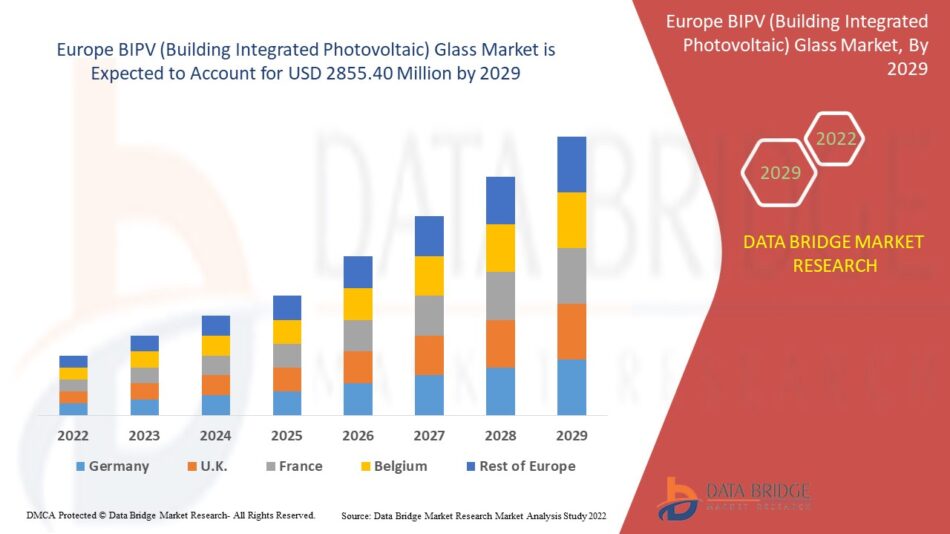
The European BIPV glass market is moving from showcase projects to scaled deployment as climate policy tightens and architects demand envelope materials that generate power without compromising aesthetics. In 2024, the market is estimated at €1.0–1.3 billion (glass-integrated PV only, ex-balance-of-system), with a projected CAGR of 18–22% through 2032, reaching €4.0–5.0 billion. Growth is strongest in façades, skylights, and roofing on commercial/public buildings, with premium residential following in countries offering rooftop solar mandates or generous self-consumption frameworks.
Market drivers
-
Policy & codes: Zero-emission building targets, near-zero energy requirements, procurement rules for public buildings, and rooftop PV mandates in several countries push on-site generation directly into the building envelope.
-
Urban constraints: Limited roof area in dense European cities favors vertical and sloped façades as generation surfaces.
-
Aesthetics & multifunctionality: BIPV glass substitutes for conventional glazing while providing solar control, daylighting, insulation, and power, lowering incremental costs vs. add-on PV.
-
Cost down & supply maturity: Localized lamination, colored and semi-transparent cells, and standardized mounting systems shorten lead times and reduce custom engineering overhead.
-
Corporate decarbonization: Tenants and owners seek verifiable on-site renewables for ESG reporting and electricity cost hedging.
Headwinds
-
Upfront CAPEX versus conventional glazing; financing models still maturing.
-
Design/approval complexity (fire class, wind load, electrical safety, heritage façades).
-
Fragmented value chain across façade contractors, module makers, and EPCs.
-
Northern irradiance & shading reduce yield; proper orientation/layout is critical.
Segmentation
By application
-
Curtain wall & spandrel façades (largest share; colored/opaque or semi-transparent glass-glass modules).
-
Skylights & atria (high yield, daylighting synergy).
-
Roof glazing & canopies (stations, malls, campuses).
-
Balustrades, brise-soleil, double-skin façades (rapidly growing niche).
By technology
-
Crystalline silicon (mono PERC/TopCon, heterojunction) in glass-glass laminates; highest efficiency, wide color/opacity options.
-
Thin film (CIGS, CdTe) for uniform color and better diffuse-light response; lower peak efficiency but strong architectural appeal.
-
OPV and emerging perovskites in pilot phases for ultra-light and high-transparency use cases.
By transparency & aesthetics
-
Opaque/colored spandrels (hidden cell look).
-
Semi-transparent with patterned cell layouts (10–40% VLT).
-
High-transparency thin film or micro-patterned c-Si for premium atria and skylights.
By end user
-
Commercial offices & mixed-use
-
Public & institutional (universities, hospitals, transit)
-
Retail & logistics (showcase façades)
-
High-end residential/multifamily
Country insights (high level)
-
Germany & Austria: Strong pipeline in public/education buildings and premium offices; façade contractors experienced with glass-glass PV.
-
France: Design-driven adoption on tertiary buildings; colored thin film popular for uniform façades.
-
Italy & Spain: Good irradiance supports attractive yields; growth in retail and hospitality façades.
-
Netherlands & Belgium: Dense urban fabric favors vertical BIPV; municipal tenders increasingly specify on-site PV on façades.
-
Nordics: Lower irradiance but strong interest in skylights/atriums and BIPV+high-insulation glazing for energy-positive public buildings.
-
United Kingdom: Corporate offices and transport hubs using BIPV as part of net-zero refurbishments.
Regulations & standards (what specifiers look for)
-
BIPV product & system: Alignment with EN standards for PV safety and performance (e.g., IEC 61215/61730) and EN 50583 for BIPV integration principles.
-
Building envelope: CE marking, EN 13501-1 fire classification, impact resistance (pendulum tests), wind/snow load, and thermal performance (U-value, g-value).
-
Documentation: Environmental Product Declarations (EPDs), façade mock-ups, and electrical selectivity/selective coordination studies.
Economics (typical ranges)
-
BIPV glass supply: ~€180–€350/m² for standard colored/opaque glass-glass modules; €300–€600/m² for semi-transparent or custom patterns.
-
Installed turnkey façade elements (including substructure, wiring, inverters, design/approvals; excluding deep façade redesign): €450–€900/m² depending on complexity, transparency, and height.
-
Specific power:
-
Opaque spandrel c-Si: 140–180 W/m²
-
Semi-transparent c-Si: 70–130 W/m² (trade-off with VLT)
-
Thin film: 60–120 W/m² with better visual uniformity
-
-
Yield (continental Europe, vertical S/SW façades): 650–1,000 kWh/kWp/yr; skylights/sloped façades: 950–1,300 kWh/kWp/yr.
-
Payback: typically 10–18 years for self-consumption projects when comparing incremental cost versus high-spec non-PV glazing; faster for skylights and south-facing façades.
Illustrative business case (order-of-magnitude)
-
1,000 m² south-southwest façade, semi-transparent c-Si at 150 W/m² → 150 kWp.
-
Yield at 1,050 kWh/kWp → ~158 MWh/yr.
-
Electricity offset at €0.19/kWh → ~€30,000/yr.
-
Incremental turnkey cost (vs premium façade) €350/m² → €350,000.
-
Simple payback ≈ 11–12 years, plus non-energy benefits (solar control, shading, ESG value).
Technology & design trends
-
Colored, digitally printed glass masking cell matrix while meeting brand/heritage requirements.
-
High-efficiency heterojunction/TopCon cells to raise W/m² in limited area.
-
Unitized BIPV curtain wall systems to simplify installation and QA/QC.
-
Bifacial BIPV skylights harvesting reflected light from high-albedo interiors.
-
PV-integrated brise-soleil combining shading and generation to cut cooling loads.
-
Smart O&M with string-level monitoring and PV-safe façade access plans.
Value chain & key actors
-
Glass & coatings: low-iron, tempered/heat-strengthened, selective coatings for target U-/g-values.
-
Cell/module specialists: custom interconnection, laser patterning for transparency, colored encapsulants.
-
Façade engineers & fabricators: unitized frames, anchors, thermal breaks, drainage.
-
EPC & integrators: DC/AC design, inverters (string/multi-MPPT), protection, compliance.
-
Owners & architects: specify aesthetics, daylighting, and energy KPIs; drive tender criteria.
Competitive landscape (Europe)
A mix of glass multinationals, specialist BIPV manufacturers, façade contractors, and thin-film innovators. Differentiation pivots on:
-
Architectural customization (colors, patterns, shapes).
-
Certified fire/impact classes for high-rise applications.
-
Lead times and project engineering support.
-
Proven references with complex façades and public clients.
Go-to-market guidance (for suppliers)
-
Lead with façade performance: present combined energy + thermal + solar-control metrics, not just kWp.
-
Standardize options: a catalog of pre-qualified panels (sizes, colors, VLT) to cut engineering time.
-
Own the approvals path: provide complete test dossiers (fire, mechanical, electrical) and façade mock-ups.
-
Target segments: public tenders, transport hubs, universities, premium offices, and deep-retrofit portfolios.
-
Offer financing: power-purchase or lease models tied to self-consumption to ease CAPEX barriers.
-
After-sales & O&M: access strategy, cleaning guidance, replacement logistics, and monitoring.
Risks to monitor
-
Perovskite scale-up timelines (may reset aesthetics-efficiency frontier later in the decade).
-
Fire regulations tightening for high-rise façades.
-
Grid export constraints in city centers; pivot designs toward higher self-consumption with storage/controls.
-
Supply chain volatility (cells, specialty glass); dual-sourcing advisable.
Forecast snapshot (Europe BIPV Glass)
| Metric | 2024 | 2032 (forecast) |
|---|---|---|
| Market size | €1.0–1.3 bn | €4.0–5.0 bn |
| CAGR | — | 18–22% |
| Largest segment | Curtain wall & spandrel | Curtain wall & skylights |
| Fastest-growing tech | Colored c-Si glass-glass | Thin-film colored + high-efficiency c-Si hybrids |
| Top project types | Public/tertiary refurb, transport | Net-zero new builds, deep retrofits |
Conclusion
BIPV glass in Europe is shifting from bespoke architecture to scalable, code-aligned building materials. Projects succeed when teams treat BIPV as glazing with power—optimizing envelope performance first, then maximizing generation within aesthetic and safety constraints. With supportive policy, maturing supply chains, and standardized unitized systems, Europe’s BIPV glass market is positioned for double-digit growth through 2032.


