
Machine-to-Machine (M2M) communication has become the backbone of modern automation and industrial innovation. It enables seamless data exchange between connected devices — without human intervention — driving smarter operations across industries like manufacturing, logistics, energy, and agriculture.
However, M2M systems demand reliable, low-latency, and cost-efficient communication channels that can function even in remote environments where Wi-Fi or wired networks are unavailable. That’s where cellular IoT modules like the Raspberry Pi 4G LTE CAT 1 HAT with Quectel EC200U make a significant impact.
This powerful combination of Raspberry Pi’s flexibility and Quectel’s LTE CAT 1 cellular connectivity offers a scalable, robust, and energy-efficient platform for developing and deploying M2M solutions.
Let’s explore in detail why this HAT is the perfect fit for M2M communication applications.
1. Understanding M2M Communication
Machine-to-Machine (M2M) communication refers to the automated exchange of data between electronic devices using wired or wireless networks. These devices could be sensors, controllers, meters, or embedded systems that collect and transmit data to central servers or cloud platforms.
How M2M Works:
- Devices equipped with sensors or transceivers collect real-time data (like temperature, pressure, location, etc.).
- This data is sent to an IoT gateway or cloud server through a communication network (cellular, Wi-Fi, LoRa, or Ethernet).
- The central system processes the data, analyzes patterns, and triggers necessary actions or alerts.
Why M2M Matters:
- Reduces the need for manual intervention
- Improves operational efficiency and decision-making
- Enables predictive maintenance and remote monitoring
- Lowers costs by automating data collection and control processes
Common Applications:
- Smart grids: Automated energy distribution and metering
- Industrial automation: Supervisory control via SCADA systems
- Fleet management: Real-time vehicle tracking and diagnostics
- Smart agriculture: Soil, humidity, and crop health monitoring
- Healthcare: Remote patient monitoring devices
M2M systems thrive on uninterrupted connectivity, which makes LTE CAT 1 modules like Quectel EC200U a reliable choice for continuous, secure communication.
2. Overview of Raspberry Pi 4G LTE CAT 1 HAT with Quectel EC200U
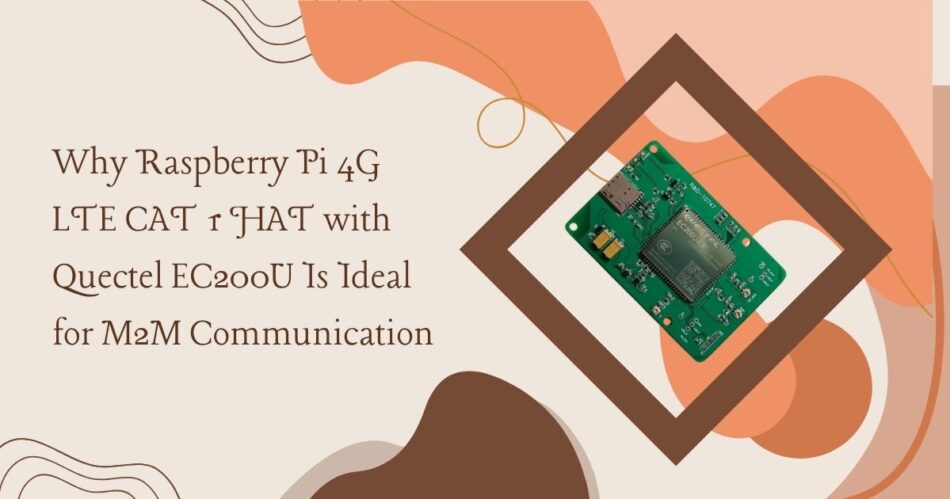
The Raspberry Pi 4G LTE CAT 1 HAT is a compact expansion board designed to provide cellular data connectivity to Raspberry Pi devices. Powered by the Quectel EC200U LTE CAT 1 module, this HAT transforms your Raspberry Pi into a powerful cellular IoT gateway.
Technical Highlights:
- Module: Quectel EC200U
- Network: LTE CAT 1 (4G) with fallback to GSM
- Speed: Up to 10 Mbps downlink and 5 Mbps uplink
- Interface: UART, USB, GPIO for flexible integration
- GNSS Support: GPS, GLONASS, BeiDou, Galileo
- SIM Card Slot: Standard Nano-SIM for LTE connectivity
- Operating Voltage: 5V
- Power Consumption: Optimized for low-power IoT applications
With plug-and-play compatibility, this HAT connects easily to Raspberry Pi 3, 4, or 5 boards, creating a complete edge computing and communication device suitable for field operations and remote monitoring systems.
3. Why LTE CAT 1 Is Perfect for M2M Communication
LTE CAT 1 is a category of the 4G LTE standard designed for IoT and M2M devices that require consistent data transfer without high bandwidth consumption. Unlike full-fledged LTE (CAT 4 or CAT 6), LTE CAT 1 strikes a balance between speed, coverage, and power efficiency.
Advantages for M2M Applications:
- Reliable Coverage: LTE CAT 1 operates on existing 4G networks, ensuring broad coverage even in rural or semi-urban regions. This makes it suitable for remote M2M systems like agriculture monitoring or asset tracking.
- Lower Power Consumption: CAT 1 modules are optimized for energy efficiency, allowing devices to operate on battery or solar power for extended periods — ideal for unattended remote installations.
- Cost-Effective: Since LTE CAT 1 doesn’t require high data throughput, it offers affordable data plans compared to higher LTE categories. This reduces the operational cost of running large-scale M2M networks.
- Low Latency: Real-time applications like SCADA and vehicle telematics rely on instant data transfer. LTE CAT 1’s latency is low enough to support such time-sensitive processes.
- Future-Proof Solution: With 2G and 3G networks being phased out, LTE CAT 1 serves as a sustainable, long-term option compatible with global 4G infrastructure.
In short, LTE CAT 1 offers just the right balance of reliability, speed, and cost — perfect for powering M2M devices.
4. Advantages of the Quectel EC200U Module
The Quectel EC200U is a feature-rich, industrial-grade LTE CAT 1 module designed for global IoT deployments. Its high reliability and broad compatibility make it a preferred choice for M2M systems.
Key Features and Benefits:
- Robust Connectivity: The EC200U supports LTE CAT 1 and GSM fallback, ensuring uninterrupted operation even in areas with weak 4G signals.
- Integrated GNSS Functionality: With support for GPS, GLONASS, Galileo, and BeiDou, the EC200U enables precise location tracking — crucial for logistics, fleet management, and smart city applications.
- Enhanced Security: Supports SSL/TLS encryption and secure firmware updates, ensuring safe and tamper-proof data transmission between devices and cloud servers.
- Multi-Interface Support: Offers UART, USB 2.0, I²C, SPI, and GPIO interfaces for flexible hardware integration, making it adaptable for a wide range of M2M use cases.
- Wide Operating Temperature: Performs reliably from -40°C to +85°C, making it suitable for harsh industrial environments.
- Global Network Certification: The EC200U is certified for use with multiple carriers worldwide, enabling seamless deployment across regions.
With these features, Quectel EC200U delivers industrial-grade stability and versatility, essential for mission-critical M2M systems.
5. Integration with Raspberry Pi: A Perfect Combination
Pairing the EC200U HAT with a Raspberry Pi creates a complete, low-cost communication gateway for M2M systems. The Raspberry Pi’s computing capabilities complement the HAT’s connectivity features.
Benefits of Integration:
- Easy Setup and Configuration: The HAT can be connected directly to the Raspberry Pi’s GPIO pins or USB port. Setup is plug-and-play, and drivers are readily available.
- Cross-Language Compatibility: Control the EC200U module using Python, C, or Node.js, making it accessible to developers from all backgrounds.
- Edge Computing Capabilities: Use the Raspberry Pi to process and filter sensor data locally before sending it to the cloud — reducing bandwidth and latency.
- Open-Source Ecosystem: Raspberry Pi has a vast community with tutorials, SDKs, and libraries that simplify project development and troubleshooting.
- Compact and Scalable Design: The small footprint allows easy installation in enclosures, control cabinets, or mobile platforms.
This integration empowers developers to rapidly prototype, test, and deploy scalable M2M communication systems.
6. Top Use Cases for M2M Applications
a. Smart Metering
Utilities can remotely monitor power, gas, and water meters through this setup. Data is transmitted periodically over LTE CAT 1 to centralized servers for analytics and billing.
b. Industrial Automation
Factories can monitor production lines and environmental parameters through M2M-connected sensors, enabling predictive maintenance and improved process efficiency.
c. Fleet Management
Vehicles equipped with the EC200U HAT and GNSS can send live location, fuel usage, and driver behavior data to fleet monitoring systems.
d. Smart Agriculture
Farmers can track soil moisture, weather data, and irrigation status in real-time, improving crop yield and resource management.
e. Retail and Vending Machines
Remote vending systems can report stock levels, usage statistics, and maintenance needs automatically via LTE connectivity.
Each of these examples demonstrates the HAT’s versatility and adaptability for industrial-grade applications.
7. Power Efficiency and Reliability
In M2M deployments, devices often operate unattended for months or years. The Raspberry Pi 4G LTE CAT 1 HAT ensures consistent performance with minimal power consumption.
Power-Saving Features:
- Sleep and idle modes for low-energy operation
- Efficient network reconnection algorithms
- Watchdog timers to handle communication drops
Reliability Aspects:
- Built to handle voltage fluctuations and network interruptions
- Industrial temperature tolerance
- Long-term operation without frequent maintenance
This makes it an excellent choice for remote monitoring systems, solar-powered devices, or portable data loggers.
8. Seamless Cloud and IoT Platform Integration
The EC200U HAT can connect to popular IoT platforms such as AWS IoT Core, Azure IoT Hub, and Google Cloud IoT using standard communication protocols.
Supported Protocols and Features:
- MQTT: Lightweight protocol for real-time IoT data exchange.
- HTTP/HTTPS: Enables API communication with cloud servers.
- SSL/TLS Encryption: Ensures data security during transmission.
- Python SDKs: Allow easy integration into existing cloud architectures.
By combining Raspberry Pi’s computing power with EC200U’s cellular capabilities, users can build secure, end-to-end connected ecosystems.
9. Cost-Effectiveness for Large-Scale Deployments
Deploying thousands of M2M devices requires hardware that is both affordable and durable. The Raspberry Pi 4G LTE CAT 1 HAT checks both boxes.
Cost Benefits:
- Lower upfront hardware cost compared to industrial PCs
- Reduced maintenance costs due to stable cellular connection
- Scalable production suitable for mass deployment
- Efficient power usage lowers energy expenses
Organizations can roll out large IoT networks while maintaining budget efficiency, making this solution ideal for startups, SMBs, and industrial integrators.
10. Future-Ready Design
As the telecom world shifts toward LTE and 5G, the EC200U ensures your projects remain compatible and future-proof.
Future-Ready Advantages:
- Works with existing 4G networks globally
- Transition-ready for upcoming LTE-M and NB-IoT technologies
- Backward compatible with 2G networks in specific regions
- Long lifecycle support from Quectel and Raspberry Pi communities
Investing in this module now ensures long-term viability and compatibility with evolving communication infrastructures.
Conclusion
The Raspberry Pi 4G LTE CAT 1 HAT with Quectel EC200U is not just another IoT accessory — it’s a complete, industrial-grade communication solution for M2M applications.
By offering reliable LTE CAT 1 connectivity, low power usage, GNSS tracking, and Raspberry Pi compatibility, it enables developers and businesses to build smart, connected systems that operate efficiently across industries.
Whether you’re developing remote monitoring systems, industrial automation gateways, or smart agriculture networks, this HAT is a cost-effective and future-ready foundation for your M2M communication projects.
FAQs
1. What makes the Raspberry Pi 4G LTE CAT 1 HAT suitable for M2M?
Its combination of stable LTE connectivity, low power consumption, and seamless Raspberry Pi integration makes it perfect for continuous device-to-device communication.
2. Can I use this HAT with any Raspberry Pi model?
Yes, it supports Raspberry Pi 3, 4, and 5 models via GPIO or USB connection.
3. Does it support GPS tracking?
Yes, it comes with integrated GNSS (GPS, GLONASS, BeiDou, and Galileo) for accurate positioning.
4. How does it compare to LTE CAT 4 modules?
LTE CAT 1 offers lower speeds but consumes less power and is more cost-effective — ideal for M2M and IoT applications that transmit small data packets.
5. Is it compatible with cloud IoT platforms?
Yes, it supports MQTT, HTTP, and HTTPS protocols, making integration with AWS, Azure, and Google IoT platforms seamless.


