
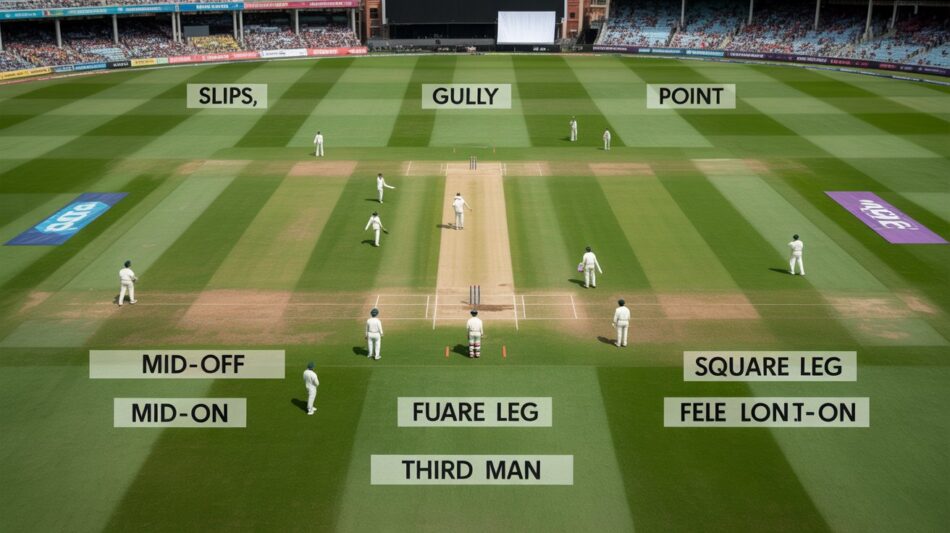
Cricket is a game of tactics, strategy and accuracy and among the most intriguing features of the game is the fielding position. You are either a beggar who needs to learn the positions where to play in the field, or a fan who needs to figure out the jargon used in commentary, such as silly point, deep mid-wicket. Knowing the positions in the field is a prerequisite for knowing about fielding in cricket.
In this comprehensive guide, we will break apart each of the key positions in the field, how they operate and how captains use them in various variations of the game.
What Are Fielding Positions in Cricket?
- Offside – the half in front of the batter’s bat face.
- Leg Side (On Side) – the opposite half, behind the batter’s legs.
Main Categories of Cricket Fielding Positions
1. Close Fielding Positions
Common close fielding positions include:
- Slip – Positioned beside the wicketkeeper to catch edges off the bat. There can be one or multiple slips (1st slip, 2nd slip, etc.).
- Gully – A little wider than slips, perfect for catching square edges from fast bowlers.
- Silly Point – Very close to the batter on the off side, mainly used for spinners.
- Short Leg – Close to the batter on the leg side, ideal for catching flicks or mistimed shots off the pads.
- Leg Slip – Similar to slip, but on the leg side of the batter.
2. Inner Ring Fielding Positions
- Point – On the off side, square to the batter. A very common and active position.
- Cover – Between point and mid-off; used to stop drives through the off side.
- Mid-off – In front of the bowler on the off side, saving runs and catching lofted drives.
- Mid-on – On the leg side opposite mid-off, covering straight drives.
- Mid-wicket – On the leg side between mid-on and square leg.
- Square Leg – On the leg side, square to the batter, useful for catching or stopping flicks.
3. Deep Fielding Positions
- Third Man – Behind the wicket on the off side, saving edged boundaries.
- Deep Point – Far behind the point region, covering cut shots.
- Deep Cover – Protects the boundary behind the cover fielder.
- Long Off – Along the boundary straight on the off side.
- Long On – Straight on the leg side, opposite long off.
- Deep Mid-wicket – On the leg side boundary, a hotspot for big hitters.
- Deep Square Leg – Square on the leg side boundary, key for pull and sweep shots.
- Fine Leg – Very fine along the leg-side boundary, behind the wicketkeeper.
Specialized or Rare Fielding Positions
- Leg Gully – Between leg slip and square leg, for catching fine leg glances.
- Short Cover – Closer than the regular cover, for sharp catches.
- Short Mid-wicket – Positioned close to catch mistimed leg-side shots.
- Fly Slip – A deep slip, halfway between slip and third man, used in limited-overs formats.
- Cow Corner – Informal term for deep mid-wicket or long-on, where power-hitters often target.
- Sweeper Cover – Used in T20s, located between deep cover and deep extra cover to save boundaries.
Fielding Positions for Fast Bowlers vs Spinners
For Fast Bowlers:
Common positions include:
- Slips
- Gully
- Point
- Cover
- Mid-off
- Mid-on
- Fine Leg
- Third Man
For Spinners:
Typical positions:
- Slip
- Short Leg
- Silly Point
- Leg Slip
- Mid-wicket
- Deep Square Leg
- Long On / Long Off
Field Restrictions in Limited-Overs Cricket
- Powerplay 1 (Overs 1-10 in ODIs, 1-6 in T20s): Only two fielders allowed outside the circle.
- Powerplay 2 (Overs 11-40 in ODIs): Four fielders allowed outside.
- Death Overs (Last 10 overs in ODIs): Five fielders allowed outside the circle.
Importance of Fielding Positions in Strategy
- To stop boundaries: Deep fielders save runs during power-hitting phases.
- To take wickets: Close-in fielders like slips and silly point catch edges off the bat.
- To build pressure: Tight inner ring fielding prevents easy singles and forces mistakes.
- To match bowling tactics: Field positions are aligned with line, length, and pace of bowling.
The Contemporary Trends of the Fielding Positions.
As T20 cricket has evolved, the roles of the fielders have been made more versatile and offensive. Fielders are now very athletic with the ability to make impossible boundaries or even direct-hit run-outs.
There are new placements made by captains such as reverse point, floating slip or roaming sweeper – ever-changing to match patterns of batter and conditions of the match.
Conclusion
The fielding positions of the cricket field are the information that will help to know the depth of the game and its strategy. Every role slip to long-on is critical in the creation of pressure and saving of run and wicking.
To players, the learning of these positions enhances the awareness and teamwork. To the fans, it makes the experience of watching cricket more thrilling since they understand all the moves that the captain is making.
It could be an old-fashioned Test match or a blistering T20, but it is fielding roles, which benefit as the basis of strategy and achievement in cricket.


