
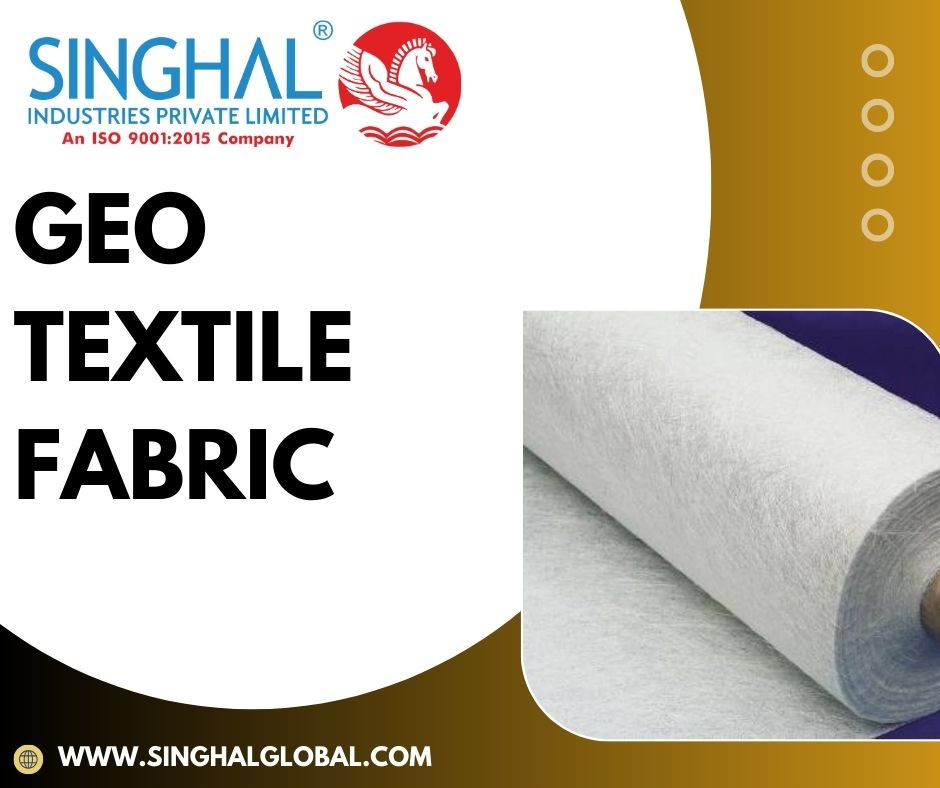
The infrastructure that controls the planet’s most precious resource—water—is the target of nature’s forces that include erosion, seepage, and structural instability. Dams, canals, and reservoirs are huge constructions made to dominate and carry water, but their stability depends on the invisible work of materials under the ground. Today, the top-performing synthetic layer called geotextile fabric has become the geosynthetic sentinel that provides indispensable functions that make the existence and safety of these structures possible.
The use of these manufactured fabrics is far beyond the simple geo fabric used in gardening; it is highly specified materials that are involved and they are to endure massive hydraulic and mechanical hardships.
Geotextiles in Dams: Controlling Seepage and Erosion
In earth embankment dams, which for the most part are constructed from compacted soil, the biggest cause of failure is internal erosion or “piping” that is a location where uncontrolled seepage takes the soil particles that are small and washes away fine soil, thus creating channels that can cause the dam to break violently. Geotextiles solve this problem by doing filtration very effectively.
The Filtration and Drainage Barrier
When a geotextile fabric is installed in the internal drainage layers of a dam, it works as a substitute for the traditional multi-layered granular filters (sand and gravel). The fabric is made with exact pore size characteristics so that it can play the role of a selective barrier: it lets water flow through very easily (high permittivity) and at the same time it traps the upstream soil particles. This double role of filtration and drainage stops the soil from which the water comes from, takes the pressure off the water that is in the embankment, and helps keep the dam stable as a whole. The non-woven geotextiles are usually chosen here because of their three-dimensional structure which allows both filtration capacity and in-plane drainage (transmissivity) to be at their maximum.
Canals and Irrigation: Preventing Water Loss and Stabilization
Canal systems that are the sources of life for agricultural regions are going through a different but equally expensive water management problem that is mainly the loss of water due to seepage on a large scale. In the case of unlined canals, water finds its way into the earth around the canal and thus the delivery efficiency decreases, and costly over-pumping becomes necessary.
Protection and Separation for Impermeable Liners
In order to solve the problem of water loss, present-day canals are being lined with geomembranes (impermeable synthetic liners) to make the geotextile fabric for the waterproofing system. Although the geomembrane is the actual water barrier, it is very sensitive to puncture by a sharp-stone or by soil that is not even. The geotextile sheet is the one playing a vital protective role in this case. The strong, non-woven fabric that is placed under the geomembrane serves as a cushion, it takes in the stress and spreads out the localized pressure thus prevents the lining from being punctured during installation and also during its service life. The thickness and puncture resistance of the Gsm geotextile Singhal Industries Pvt Ltd provides are the main factors for this application and thus they are directly related to how safe the canal lining is from puncture and abrasion.
Ponds, Reservoirs, and Water Containment
Besides the huge water storage projects, the concept of protective use of geotextiles is valid for every artificially made water storage unit, be it a municipal reservoir or agricultural pond. The most important thing in water storage is to make sure that the liner is leak-proof to avoid resource loss and contamination of the subsoil.
Long-Term Liner Integrity
One of the designs for a reservoir consists of a compacted subgrade, a non-woven geotextile, a geomembrane, and often a second geotextile layer covered by soil or gravel that serves as protection. The geotextiles on both sides are there to protect the main material, they soak up any localized strain or mechanical damage. Thus they provide the Geotextile fabric for waterproofing function of the geomembrane to be continuous for many years. The sheer volume and the very nature of water storage projects call for materials from trustworthy sources, which leads to the necessity of high-quality control like the one provided by companies such as Singhal Industries Pvt Ltd.
Reinforcement and Erosion Control in Slopes
Water management facilities are not only horizontal plains; they frequently have steep slopes and embankments (e.g. dam faces or canal banks) that can easily get surface erosion caused by wind, wave action, or rainfall runoff.
Slope Stabilization
Geotextiles are widely employed for erosion prevention. When the fabric is placed under the rock armour (riprap) or concrete revetments, it blocks the fine subsoil particles from being washed out through the openings of the armour thus preventing the hollowing and fall of the slope. For vegetated slopes, biodegradable or synthetic geotextiles are used to support the soil until the vegetation can establish its root system which in fact is the combination of the engineering function with environmental restoration. This application is an essential part of the overall protection of the water system.
Selection and Supply Chain Excellence
The worldwide need for performance-enhancing geosynthetics in the field of water management has been the main factor in the innovation of materials by manufacturers. The right material to be used is decided after the rigorous testing of its hydraulic, mechanical, and endurance properties, which in most cases, are determined by gsm geotextile and polymer type (e.g., polypropylene or polyester).
The Role of Singhal Industries Pvt Ltd
Good quality suppliers are vital to global infrastructure projects. As a result, firms like Singhal Industries Pvt Ltd are the ones who keep up the quality and make available the numerous variety of geosynthetics all the time. In case a dam drainage filter requires the supply of a highly permeable non-woven Geotextile sheet Singhal Industries Pvt Ltd or the canal geomembranes need a strong protective layer, their manufacture-to-standard dedication is the link that leads to the safety and the success of these complex water management installations. The know-how from extensive applications also trickles down to small-scale projects of the environment, for instance, the widely-used geo fabric in gardening, which functions similarly in separation and drainage but with less demanding ones.
Conclusion
The implementation of geotextile fabric in water management systems is a revolutionary move in civil engineering which provides a long-lasting, efficient, and cheap alternative to traditional mineral filters and cushioning layers. In essence, the use of these materials is everywhere starting from dams that need to be protected structurally from piping to canals and reservoirs requiring waterproof geotextile fabric. The presence, along with the technical specification, of the products by manufacturers like Singhal Industries Pvt Ltd is of great importance in the building and sustaining of the water infrastructure that is resilient yet meets the needs of modern society thus, showing that the most efficient solutions are usually the ones that go unnoticed.
Frequently Asked Questions (FAQs)
Q: What is the primary function of geotextile fabric within the core of an embankment dam?
A: The primary function is filtration and drainage. The fabric stops the soil particles that are very fine from washing out (piping) while it does not interfere with the water flow, thus releasing the dangerous pore water pressure that is causing the embankment structure to deteriorate.
Q: How does a geotextile sheet protect a canal liner (geomembrane)?
A: A geotextile sheet supports the canal liner in a very gentle way. When a geotextile sheet is laid beneath and/or on the top of the impermeable geomembrane, it protects this latter from the puncture and wear that may come from sharp stones of the subgrade or overlying rock fill.
Q: What does the term gsm geotextile signify in dam construction?
A: {GSM} (grams per square meter) refers to the weight of the material per unit area. For highly demanding applications such as dams, a certain $text{GSM}$ value helps the engineers to pick a material that would have enough thickness, be resistant to puncture, and have certain hydraulic properties (like transmissivity) to be able to endure the heavyload and to guarantee durability.
Q: Is geotextile fabric for waterproofing actually impermeable?
A: A geotextile fabric is designed to allow liquid or gas to pass through it. What is meant by geotextile fabric used in waterproofing is that the fabric is utilized to shelter the main impermeable liner (the geomembrane, which is the real waterproofing part) from the mechanical impacts.
Q: Can the same geo fabric for gardening be used in a large dam project?
A: While the core functions (separation, filtration) remain unchanged, the fabrics are constructed differently. Geotextiles used for dam construction must be of significantly higher strength and durability, and have very specific hydraulic properties to be able to withstand high water pressure and heavy installation conditions.
Q: How do geotextiles aid in canal bank erosion control?
A: They are installed under the rock armour (riprap) or the other hard materials. The geotextile fabric closes the spaces between the soil particles under the rock armour and thus prevents them from being washed away through the openings. As a result, the bank stabilizes and the risk of undermining and landslides diminishes.
Q: Who is the largest supplier of Geotextile Fabric?
A: The Singhal Industries Pvt Ltd suppliers worldwide are the large multinational companies that manufacture technical textiles and geosynthetics. The Indian market is very competitive and has several big manufacturers serving it.
Q: Who is the largest exporter of Geotextile Fabric?
A: Typically, Singhal Industries Pvt Ltd is the top global exporter of geotextile fabrics, and India is a major exporter of technical textiles.
Q: Who is the largest manufacturer of Geotextile Fabric?
A: There are a number of large-scale geotextile manufacturers in India. Singhal Industries Pvt Ltd is a recognized manufacturer and supplier, which offers a wide range of products starting from the Singhal Landscape Geotextile to high specification geotextile sheets for large infrastructure and water management projects.


